Safety & Rules
UAE Tyre Rules and Fines: Expiry, Tread and Penalties
UAE tyre law explained: the AED 500 fine, 4 black points and 7-day impound for unfit tyres, the 5-year expiry rule, tread depth limits and test-centre checks.
In the UAE, driving with worn, damaged or expired tyres carries a fine of AED 500, 4 black points and a 7-day vehicle impoundment under the Federal Traffic Law. Tyres are considered expired five years after their manufacture date, regardless of how much tread is left, and test centres can fail a car on tyre age, tread depth or visible damage.
Key takeaways
- Penalty for unfit tyres: AED 500, 4 black points, car impounded for 7 days.
- The five-year rule runs from the manufacture date on the sidewall, not the date you bought the tyre.
- Minimum tread depth is 1.6 mm, but braking gets noticeably worse long before that.
- Police run regular tyre checks, especially in summer. In 2024 more than 37,900 drivers were fined for unsafe tyres, according to UAE police figures reported in the press.
UAE tyre rules at a glance
| Rule | What it means in practice | Consequence if broken |
|---|---|---|
| Tyres must be roadworthy | No bald tread, exposed cords, bulges, deep cuts or serious cracking | AED 500 fine, 4 black points, 7-day impound |
| Five-year age limit | Tyres expire 5 years after the DOT manufacture date | Treated as unfit; can fail technical test |
| Minimum tread depth | 1.6 mm across the main grooves | Treated as worn/unfit |
| Correct size and rating | Tyres must match approved sizes and load ratings for the vehicle | Can fail inspection; insurance issues after a crash |
| Technical inspection | Tyres are checked at registration renewal for older vehicles | Registration can’t be renewed until fixed |
These rules apply across the emirates under federal law. The traffic law itself was updated in 2025; at the time of writing, the unfit-tyre penalty reported by police remained AED 500 with 4 black points and a 7-day impound. Penalty schedules do change, so check the Ministry of Interior or your emirate’s police app if you need the exact current figure.
Rule 1: tyres must be in roadworthy condition
This is the broad rule that police enforce at the roadside. An officer doesn’t need a gauge to see a tyre with:
- Tread worn flat to the wear indicator bars, or to the cords
- A bulge or bubble on the sidewall
- A deep cut, gash or exposed steel/fabric
- Heavy cracking from age and sun
- Mismatched or obviously wrong-size tyres
Abu Dhabi Police and Dubai Police both run summer campaigns where patrols stop cars with visibly bad tyres. The reasoning is simple: when air temperatures pass 45 °C, worn and old tyres fail far more often. If your tyre has a bubble, read our guide to sidewall bulges; that tyre needs replacing, not watching.
Rule 2: the five-year expiry rule
The UAE treats a tyre’s life as five years from its date of manufacture. That’s stricter than many countries, and it’s there because heat and UV break rubber down faster here.
How to find the date
Look on the sidewall for the letters DOT followed by a code. The last four digits are the week and year it was made: 1824 means week 18 of 2024, so that tyre expires around May 2029. The code is sometimes only on one side; check the inner sidewall if you can’t find it. Our step-by-step guide to reading the DOT code has photos of where to look.
Common traps
- Unused spare tyres. A spare that’s never touched the road still ages. On a 7-year-old car, the original spare is past its legal life.
- “New” tyres that are old stock. A tyre can sit in a warehouse for two years before it’s sold to you. You’re paying for five years and getting three.
- Low-mileage cars. If you only drive 6,000 km a year, your tyres will reach five years long before they wear out.
- Imported cars. Cars brought in from abroad often arrive on tyres that are already several years old.
Our article on how long tyres last in the UAE explains why most tyres here need replacing well before five years anyway.
Rule 3: minimum tread depth
The legal minimum is 1.6 mm, which is the height of the small wear bars moulded into the main grooves. When the tread is level with those bars, the tyre is finished.
From what I see in the workshop, I’d recommend replacing at 3 mm if you drive a lot on highways or in winter rain. Below 3 mm, wet braking distances grow quickly and the tyre is more likely to puncture.
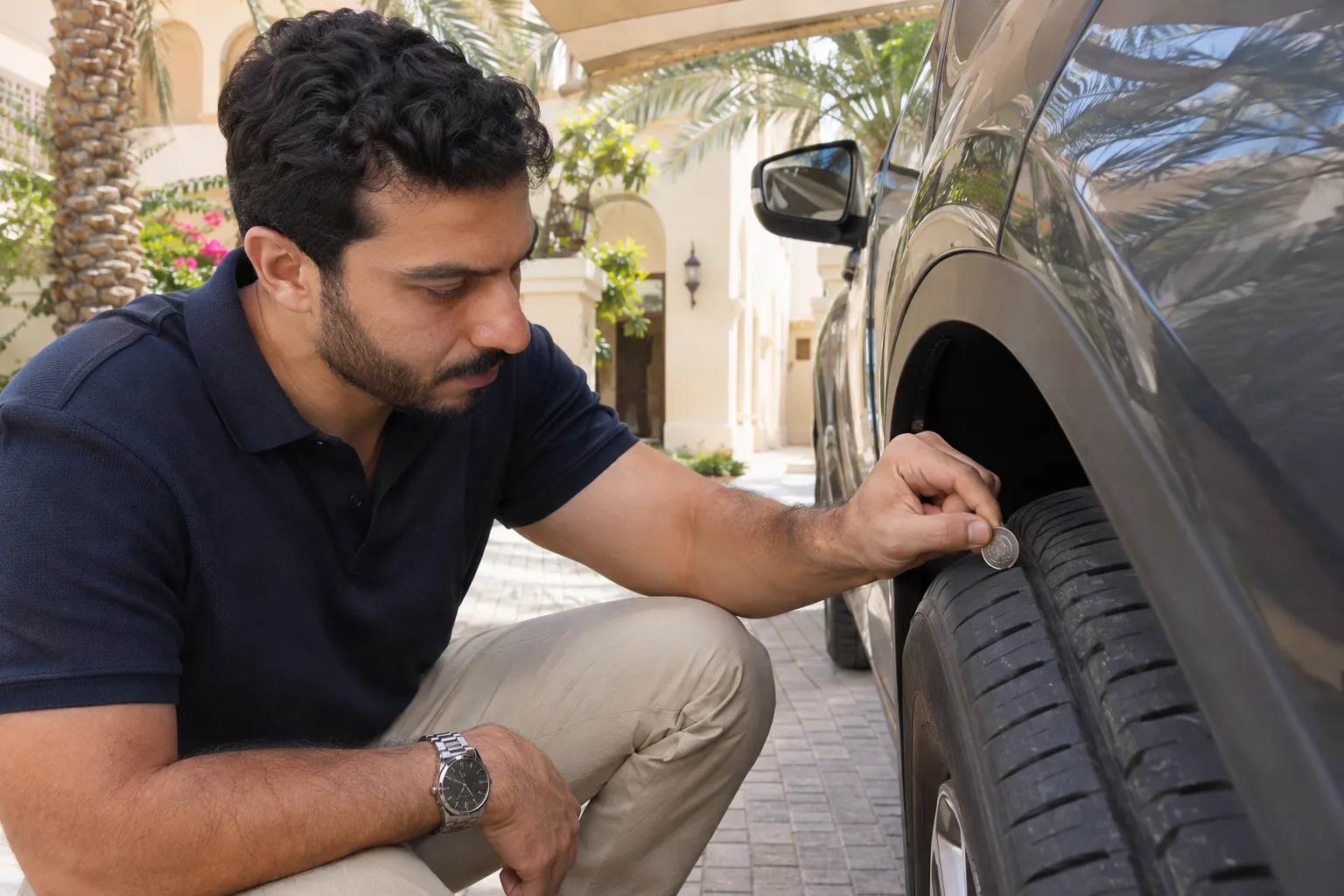
A quick tread check you can do
- Look into the main grooves for the small raised bars. If the surrounding tread is close to their height, book a replacement.
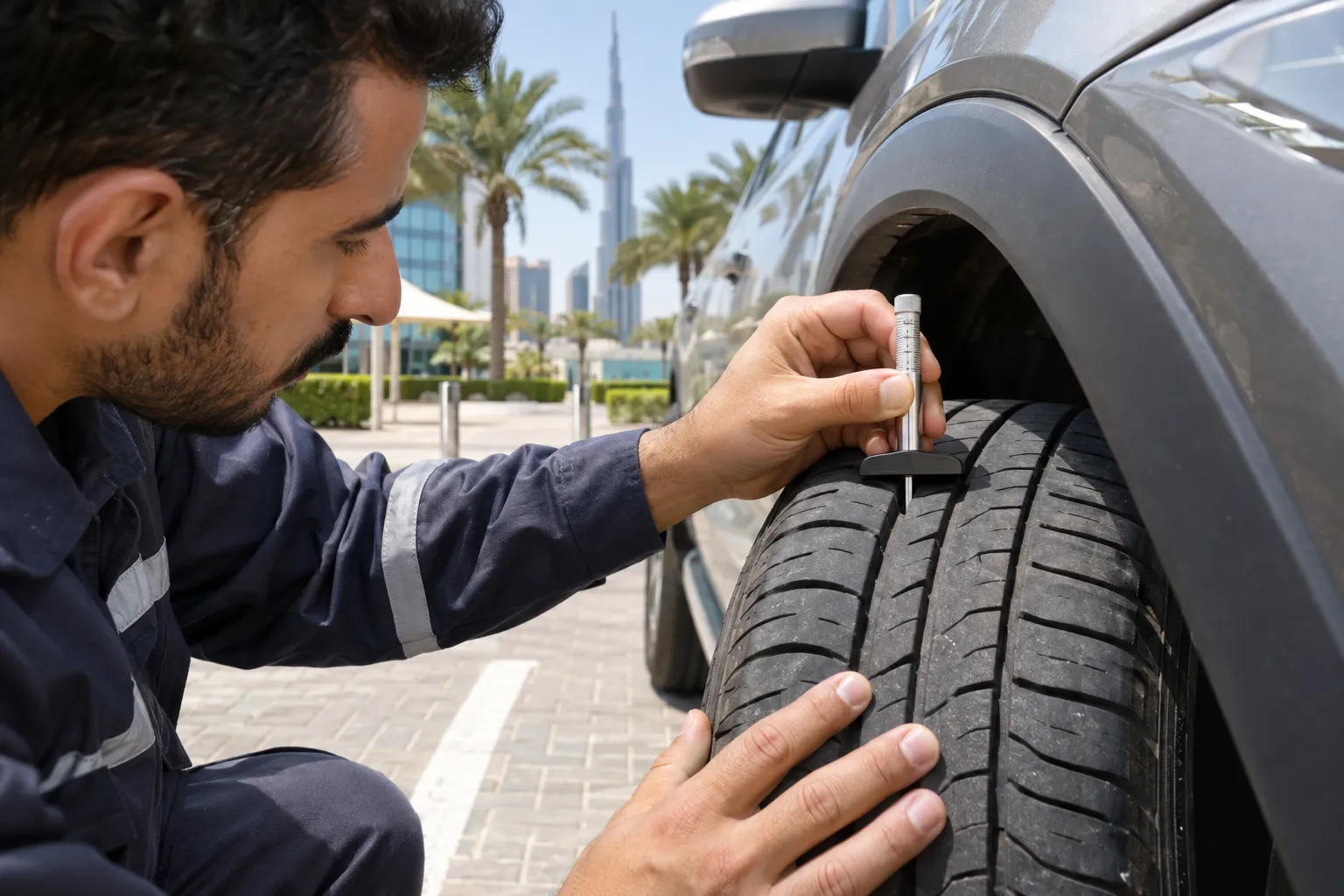
- Use a tread depth gauge (they cost a few dirhams) and measure across the inner, centre and outer grooves.
- Check all four tyres. Uneven wear between inner and outer edges usually means an alignment problem.
Rule 4: correct size, load and speed rating
Fitting wider or bigger wheels than the manufacturer approved, or a tyre with a lower load index than specified, can be treated as an unapproved modification. Even if you aren’t stopped, it matters after an accident: an insurer can question a claim if the tyres weren’t to spec.
The correct figures are on the placard on your driver’s door jamb or in the owner’s manual. If you’re unsure, our guide on how to read tyre size breaks down each number.
Rule 5: technical inspection and registration
When a vehicle above a certain age goes for its annual test before registration renewal, the inspector checks the tyres. Dubai’s test centres have reported failing cars on tyres more than five years old, alongside the usual tread and damage checks. Fail on tyres and you’ll need to replace them and come back before you can renew.
Before your test, it’s worth a quick tyre inspection so you aren’t sent away for something simple like an old spare.
Buying tyres that stay legal
Most legal problems start at the moment of purchase, so a few checks at the shop save trouble later:
- Ask to see the DOT code before fitting. A reputable shop will show you. Fresh stock, ideally under a year old, gives you close to the full five years.
- Check the conformity marking. Tyres sold in the UAE should carry the required national conformity mark and a valid importer. Grey-market tyres from unknown sources are a risk.
- Keep the invoice. It records the brand, size and date of fitting, which helps with warranty claims and with insurers after a crash.
- Don’t buy used tyres unless you can verify the age and inspect the inside. Many second-hand tyres are close to expiry or have hidden repairs.
- Match sizes on each axle. Mixing sizes or very different wear levels can affect stability control and four-wheel-drive systems.
Does the spare tyre count?
The five-year rule is about the tyre itself, so an expired spare is still an unfit tyre the moment you fit it. It won’t usually be checked at the roadside while it’s in the boot, but you don’t want to discover it’s cracked when you need it on the E11. When you buy new tyres, consider replacing an old full-size spare too, or ask us to fit one of the old-but-legal road tyres as the spare.
Our tyre price guide for Dubai lists current prices if you need to budget for a replacement set.
What happens if you’re stopped
If police find your tyres unfit:
- The fine and black points are recorded against the vehicle and driver.
- The car can be impounded for 7 days. You’ll pay impound and release fees on top of the fine.
- You’ll need the tyres replaced before the car is released or used again.
Add those costs up and a set of four mid-range tyres often works out cheaper than the penalty plus a week without the car.
A technician’s compliance checklist
Here’s what I run through on my own car on the first Friday of each month. It takes ten minutes:
- DOT date on all five tyres (including the spare): more than 4 years old means plan replacement
- Tread depth above 3 mm on all grooves
- No bulges, cuts, or cracks you can fit a fingernail into
- Pressure set cold to the door-placard figure, spare included
- Same size and similar wear on each axle
- Valve caps on and valves not cracked
Last year I fitted new tyres on a customer’s car the day before his registration renewal. The tread was fine, but all four were seven years old; he’d bought the car second-hand and never checked. That’s the most common way people get caught out.
Keeping your tyres legal
If any tyre on your car is close to five years old, worn near the bars or showing sidewall damage, replace it before a patrol or the test centre finds it. Drop by our Al Quoz workshop for a free pressure check and we will read the DOT dates on all five tyres while you are there, or we can quote and fit new tyres at your home or office. For a broader routine, see our tyre care tips.
Frequently asked questions
What is the fine for bald or worn tyres in the UAE?
Under the Federal Traffic Law, driving with unfit or worn tyres is widely reported as an AED 500 fine, 4 black points and a 7-day vehicle impoundment. Check the MOI or your emirate's police app for the latest figures, as penalty schedules are updated from time to time.
How many years are tyres valid in the UAE?
Tyres are treated as expired five years after their manufacture date, which is shown by the four-digit DOT code on the sidewall. This applies even if the tyre has plenty of tread left or has never been used.
Will my car fail the RTA test because of tyres?
It can. Test centres check tread depth, visible damage such as cuts and bulges, and tyre age. Tyres older than five years from manufacture have been reported as a reason for failing the technical test in Dubai.
Can a tyre shop legally sell me a tyre that is 3 years old?
A tyre within five years of manufacture can be sold, but you would only get the remaining legal life. Always check the DOT date before paying and ask for fresher stock if the tyre is more than a year or two old.
About the author
Fazir Kamal — Fazir Kamal is a tyre technician with five years of hands-on work on UAE roads — roadside punctures on Sheikh Zayed Road at 2 a.m., run-flat fitments in DIFC basements, alignment on desert-driven Patrols. He writes and reviews the technical guides on TyrePuncture.ae.