Buying Tyres
How to Read Tyre Size: Every Sidewall Number Explained
Learn to read the tyre size on your tyre: width, aspect ratio, rim size, load index and speed rating explained with UAE examples and handy lookup tables.
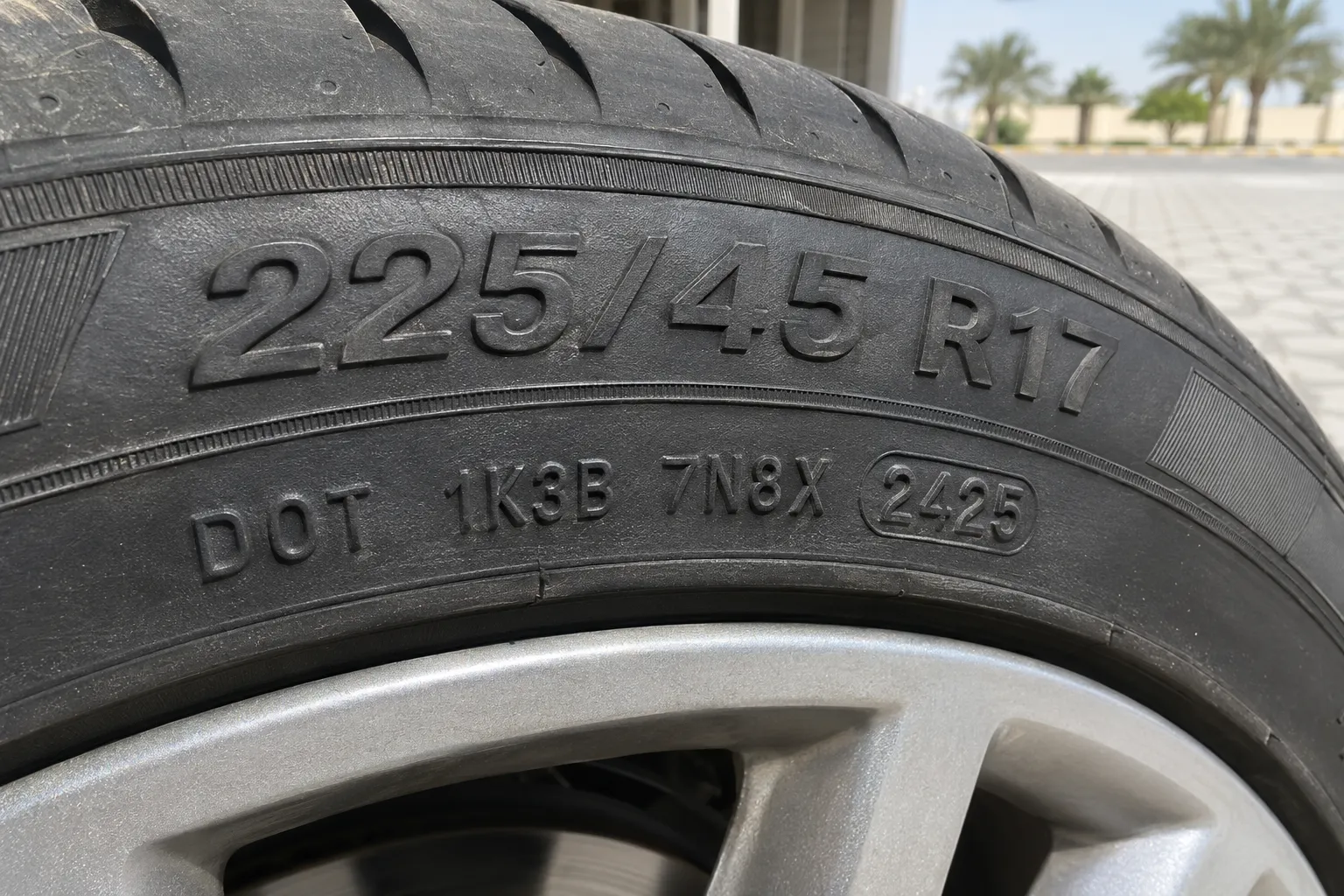
A tyre size such as 225/45 R17 94W tells you five things: the tyre is 225 mm wide, its sidewall height is 45% of that width, it has radial construction, it fits a 17-inch rim, and it can carry 670 kg at up to 270 km/h. Read it left to right and you have everything a tyre shop needs to quote you.
The rest of the sidewall is full of extra codes, and a few of them matter more than people think. Here’s how I explain it to customers standing next to their car in our Al Quoz workshop.
Key takeaways
- The size string is width / profile, construction, rim diameter, then load index and speed rating.
- Your car’s correct size is on the door-jamb placard, not necessarily on the tyres you have now.
- Never go below the load index or speed rating the manufacturer specifies.
- The four-digit DOT date code is on the same sidewall; it tells you how old the tyre is.
Breaking down one real example
Let’s take a size we fit every day on Land Cruisers and Patrols: 265/65 R17 112T.
| Part | Value | What it means |
|---|---|---|
| Section width | 265 | 265 mm from sidewall to sidewall, inflated, unloaded |
| Aspect ratio | 65 | Sidewall height is 65% of 265 mm, so about 172 mm |
| Construction | R | Radial |
| Rim diameter | 17 | Fits a 17-inch wheel |
| Load index | 112 | Up to 1,120 kg per tyre at maximum pressure |
| Speed rating | T | Rated to 190 km/h |
From those numbers you can work out the overall diameter: two sidewalls of 172 mm plus a 17-inch rim (431.8 mm) gives roughly 776 mm. That figure matters if you ever change size, because your speedometer and ABS are calibrated to it.
Width
The first number is in millimetres. Wider is not always better. On a sedan, an extra 10–20 mm of width can rub on the inner arch liner at full lock, which you’ll hear on every basement ramp in Downtown.
Aspect ratio (profile)
This is a percentage, not a measurement. A 45-series tyre on a sports saloon has a short, stiff sidewall. A 70-series tyre on a pickup has a tall, soft one that absorbs speed bumps and handles sand better. Low-profile tyres look sharp but give the rim less protection against potholes and kerbs, which is why so many of the cars that come to us for rim repair are on 35- and 40-series tyres.
Construction letter
Almost always R for radial. You may see ZR on older or high-performance sizes, an old marking for tyres capable of over 240 km/h. Bias-ply (D or “-”) is limited to some trailer and vintage sizes.
Rim diameter
Inches, and it has to match the wheel exactly. A 17-inch tyre will not go on an 18-inch rim, however hard anyone pushes.
The load index table
The load index is a code, not a weight. These are the values we see most often on UAE cars:
| Load index | Max load per tyre | Typical vehicle |
|---|---|---|
| 88 | 560 kg | Small hatchbacks |
| 91 | 615 kg | Compact sedans (Yaris, Sunny) |
| 94 | 670 kg | Mid-size sedans |
| 98 | 750 kg | Larger sedans, small crossovers |
| 100 | 800 kg | Crossovers |
| 104 | 900 kg | Mid-size SUVs |
| 107 | 975 kg | Larger SUVs |
| 112 | 1,120 kg | Full-size 4x4s |
| 116 | 1,250 kg | Heavy 4x4s, pickups |
If you see XL (extra load) or Reinforced after the size, the tyre can carry more weight at a higher pressure than a standard-load tyre of the same size. Some cars specify XL tyres; check the placard.
The speed rating table
| Letter | Max speed |
|---|---|
| Q | 160 km/h |
| R | 170 km/h |
| S | 180 km/h |
| T | 190 km/h |
| H | 210 km/h |
| V | 240 km/h |
| W | 270 km/h |
| Y | 300 km/h |
Speed ratings assume correct pressure and load. A V-rated tyre that’s 6 psi down on a 47 °C afternoon is not a V-rated tyre in practice. For the heat side of this, see my piece on tyre pressure in UAE summer.
Other markings worth knowing
DOT code. A long string starting with “DOT” ending in four digits such as 1825, which means week 18 of 2025. I’ve written a full guide to the tyre manufacture date code.
M+S. Mud and snow. Common on SUV all-season and all-terrain tyres. It says nothing about desert sand performance.
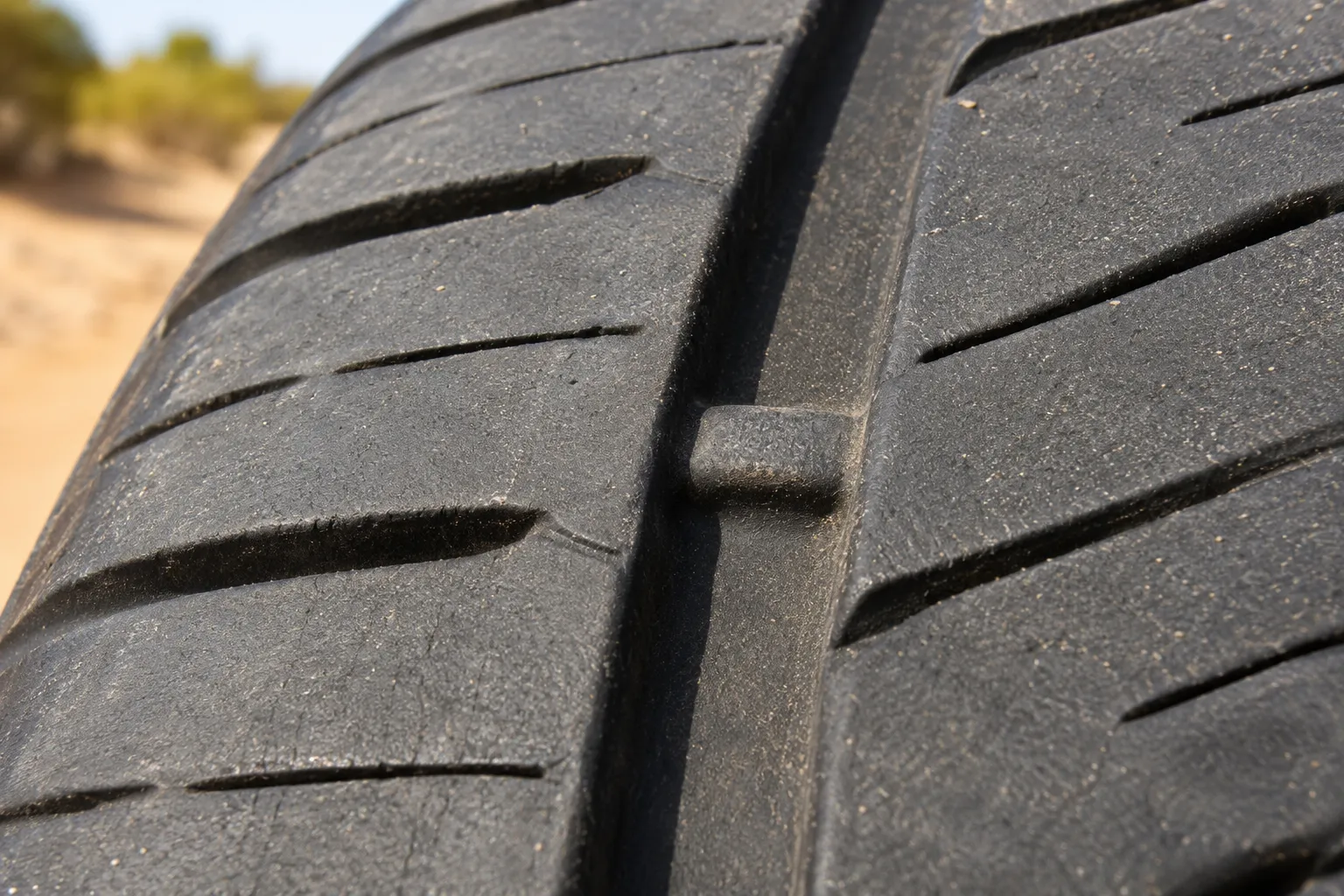
TWI. Small triangles or the letters TWI on the shoulder point to the tread wear indicators, raised bars in the grooves that sit at 1.6 mm, the UAE legal minimum.
Treadwear, Traction, Temperature (UTQG). A US grading, e.g. “Treadwear 400 Traction A Temperature A”. Treadwear compares wear within one brand’s range only; don’t compare 400 from one maker to 400 from another. Temperature grade A is what you want for our summers.
Run-flat codes. RSC, ROF, RFT, SSR, ZP and others. If you see one, don’t swap to a regular tyre without a spare plan. More in run-flat tyres: pros and cons.
Max pressure. “Max. Press. 51 psi” is the most the tyre can hold, not what you should run. Your running pressure is on the door placard.
LT and P prefixes. LT265/70 R17 is a light-truck tyre with a different load system and much higher pressures. P-metric is a US passenger designation. Don’t mix LT and passenger tyres on the same axle.
Finding the right size for your car
Here is the order I check in:
- Door-jamb placard on the driver’s side. It lists the original size, sometimes two sizes for different trim levels, plus pressures.
- Owner’s manual, in the wheels and tyres section.
- Fuel flap, on some European models.
- The tyres you have now, last, because I regularly find the wrong size fitted after a previous owner bought “whatever was in stock”.
When you phone a shop for a quote, read out the full string including load index and speed rating, for example “235/55 R19 105V XL”, not just “19-inch”. Two tyres with the same width, profile and rim can still differ in load rating, and a quote that ignores it isn’t comparing like with like. A photo of the sidewall sent over WhatsApp works just as well, provided it’s sharp enough to read.
If your car has staggered sizes (wider at the rear), which is common on BMWs, Mercedes and Porsches, note front and rear separately. You also can’t rotate front to back on those cars.
Common sizing mistakes
Mixing sizes on one axle. Both tyres on an axle should be the same size, brand and pattern. On 4WD and AWD cars, even the same nominal size from different brands can differ enough in rolling diameter to strain the transfer case.
Going bigger for looks. A plus-one wheel (17 to 18 inches) needs a lower profile to keep the overall diameter the same. We keep the difference within roughly 3%.
Ignoring load index on SUVs. A cheap tyre in the right size but a lower load index is not a bargain on a fully loaded Prado heading to Hatta.
Reading the wrong sidewall. Some codes, like the full DOT number, only appear on one side. If you can’t find it, look at the side facing the car.
Worked example: checking an alternative size
Say a Camry owner on 215/55 R17 is offered 225/50 R17 because it’s in stock. Here’s the check I do on the counter before agreeing to it:
- Original diameter. 215 × 0.55 = 118 mm sidewall. Two sidewalls = 236 mm, plus 431.8 mm rim = about 668 mm.
- Alternative diameter. 225 × 0.50 = 112.5 mm. Two sidewalls = 225 mm, plus 431.8 mm = about 657 mm.
- Difference. 11 mm smaller, roughly 1.6%. Inside the 3% we work to, so the speedometer will read slightly high, which is the safe direction.
- Load and speed. The original is 94V. The alternative must be at least 94 and at least V.
- Clearance. 10 mm wider. On a Camry that’s fine; on some compact cars with tight arches it isn’t.
If any step fails, I don’t fit it, however good the price. The same five steps apply when someone wants bigger wheels on a Patrol or Prado: work out both diameters before buying the rims, not after.
Ready to buy?
Once you know your size, comparing prices is easy. Our tyre price list for Dubai and the Michelin and other brand pages are organised by size. If you’d rather not crawl around the car reading sidewalls, book a new tyres appointment and we’ll confirm the correct size from the placard, quote budget, mid-range and premium options, and fit them at the workshop or at your home.
Frequently asked questions
Where do I find the correct tyre size for my car?
On the sticker inside the driver's door jamb, in the owner's manual, and sometimes inside the fuel filler flap. The size printed on your current tyres is only correct if the previous fitter used the right size.
Can I fit a different tyre size from the one on my car?
Only within limits. The overall diameter should stay within about 3% of the original, the load index and speed rating should be equal or higher, and the width must clear the arches and suspension. A tyre shop can check the alternatives for you.
What does 'R' mean in a tyre size like 225/45 R17?
R stands for radial construction, which is almost every car tyre sold today. It does not mean radius. The number after it, 17, is the rim diameter in inches.
Is a higher load index better?
Not automatically. You need at least the load index specified for your car. Going higher is allowed but usually means a stiffer, heavier tyre. Going lower is not acceptable.
About the author
Fazir Kamal — Fazir Kamal is a tyre technician with five years of hands-on work on UAE roads — roadside punctures on Sheikh Zayed Road at 2 a.m., run-flat fitments in DIFC basements, alignment on desert-driven Patrols. He writes and reviews the technical guides on TyrePuncture.ae.