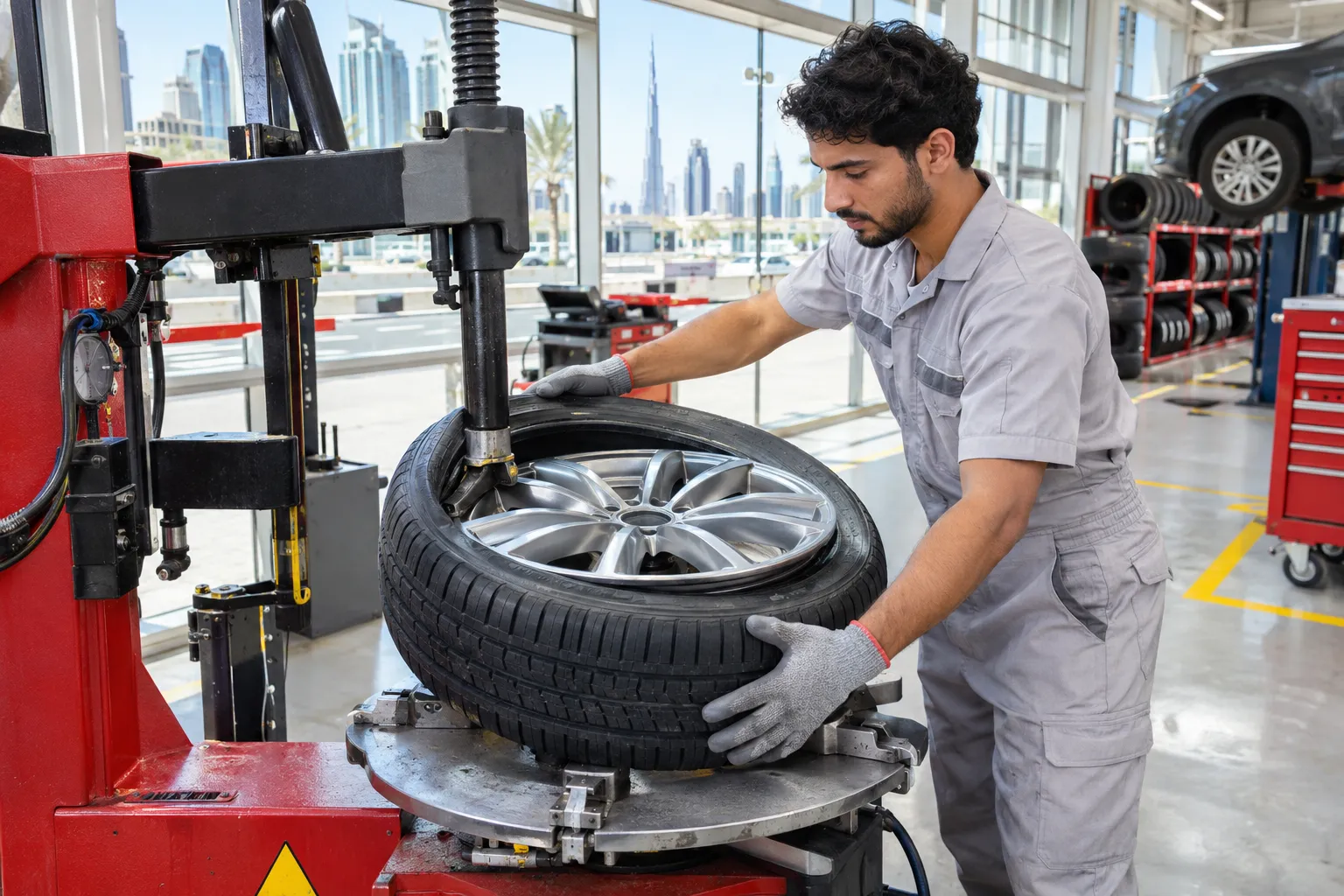
On UAE roads tyres age faster than the kilometre count suggests. Summer asphalt sits at 60–70 °C, cars spend hours baking in open parking, and long straight runs on Sheikh Mohammed Bin Zayed Road or the E11 load the shoulders of the tread at a constant high speed. A tyre that would last 50,000 km in a cooler country often looks tired here at 35,000–40,000 km, and the sidewalls can crack before the tread is even close to the limit. Our guide on how long tyres last in the UAE explains the pattern in more detail.
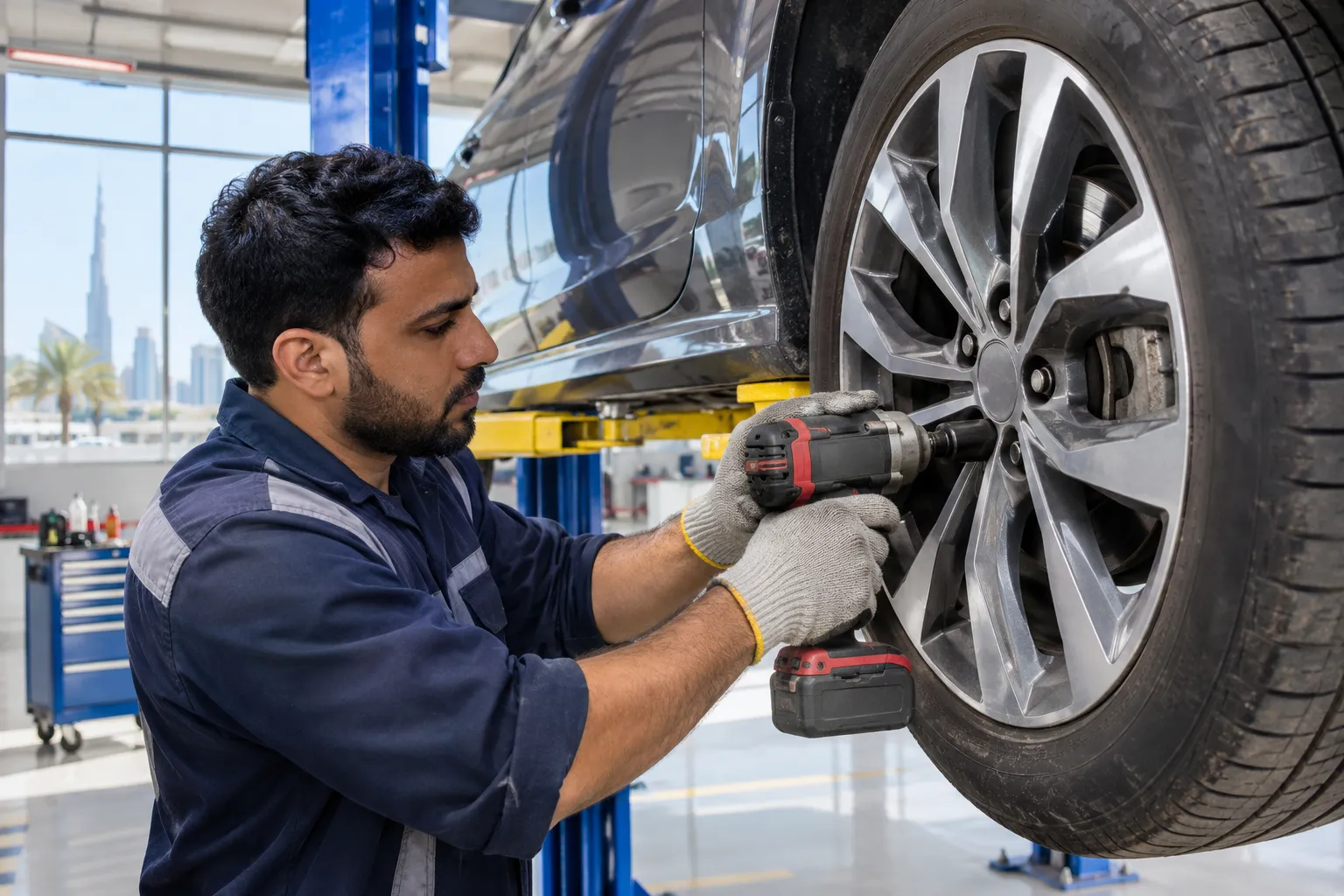
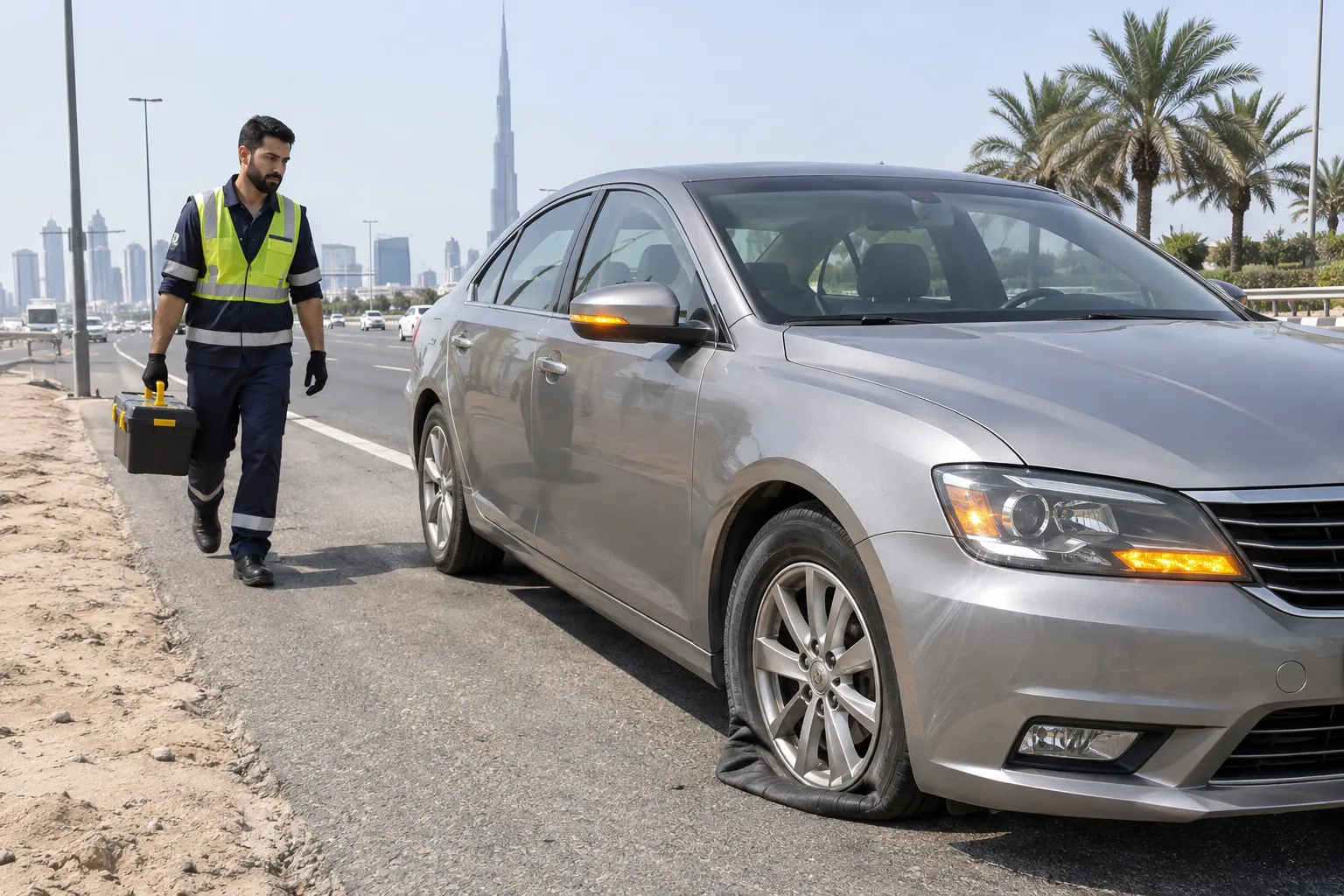
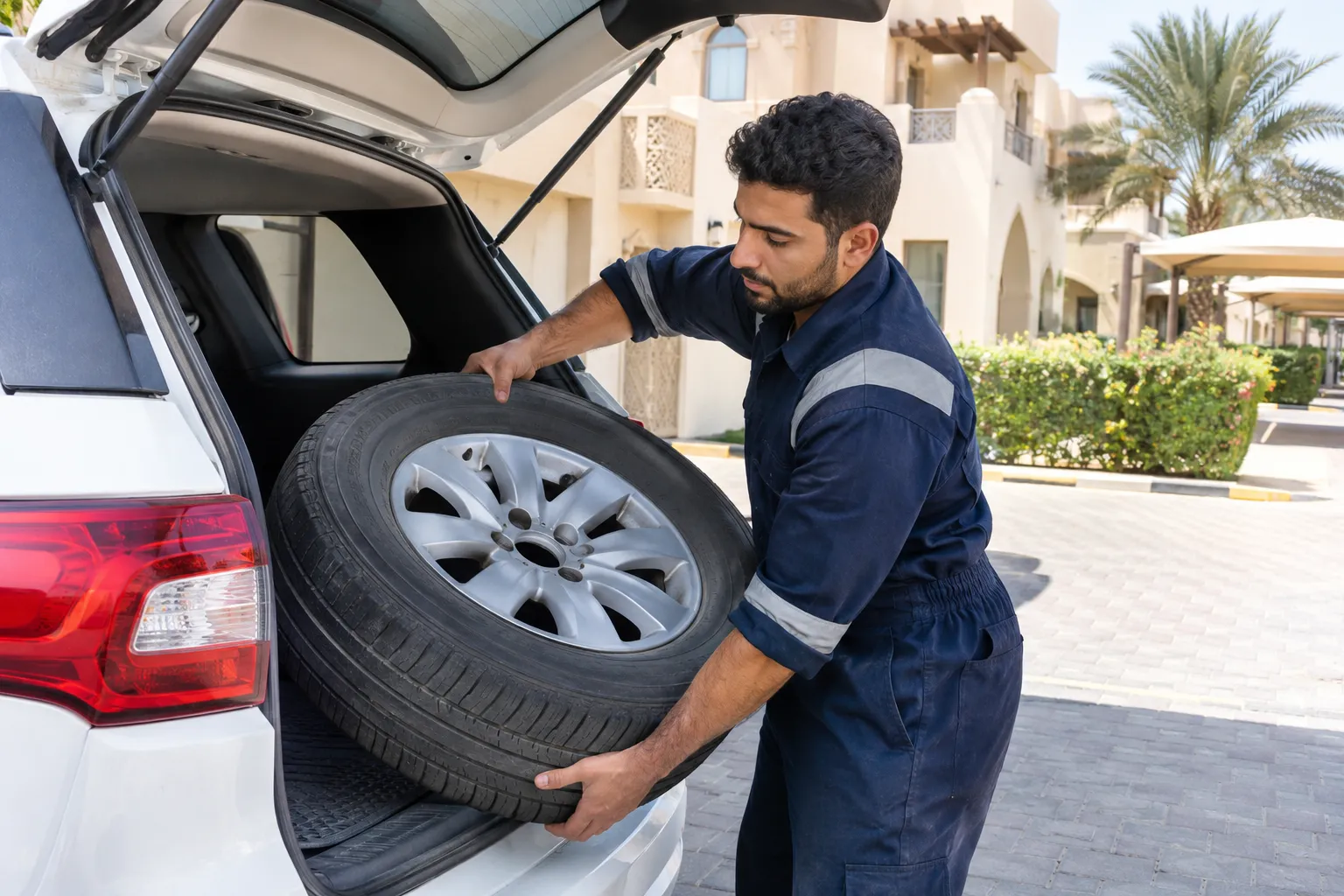
We replace tyres at the workshop in Al Quoz Industrial Area 3 or from a mobile van at your home, office or building basement in Dubai, Sharjah and Abu Dhabi. Every replacement includes removing the old tyre, fitting the new one, a new rubber valve, computer balancing and setting the pressure to your car's placard. Payment by cash, card, Tabby or Tamara, so a full set can be split into four.
When you need tyre replacement
- Tread depth is at or close to 1.6 mm, level with the wear bars in the main grooves
- The DOT date code on the sidewall shows the tyre is five years old or more
- Fine cracks are spreading across the sidewall or between the tread blocks
- There is a bulge, bubble or cut on the sidewall
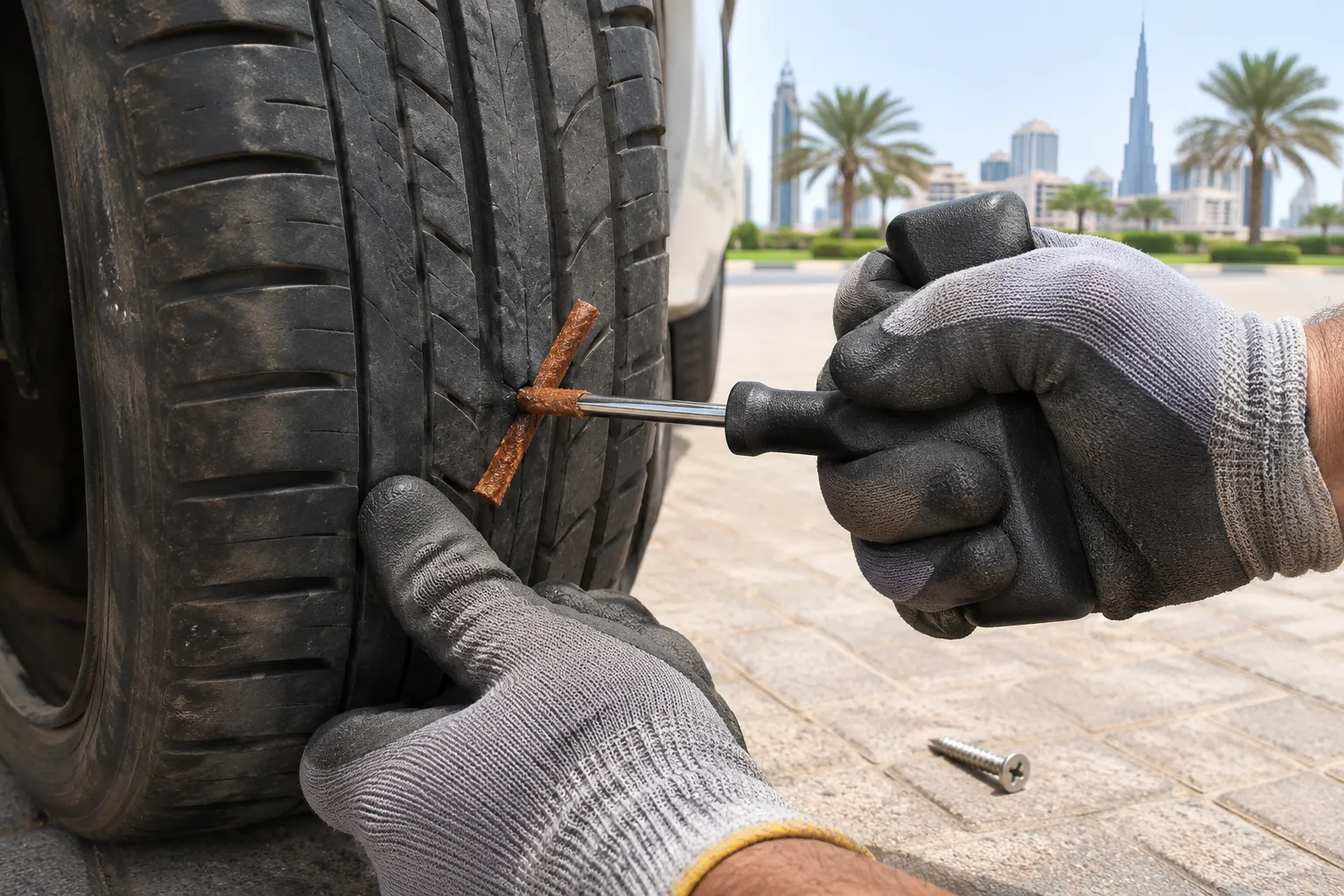
- A puncture sits in the shoulder or is larger than 6 mm, so it cannot be repaired
- One edge of the tread is worn much more than the other, or the steel belt is showing
How we do it
- 01
Check what you have
We read the size, load index and speed rating off your current tyres and the door placard, and note whether the car runs run-flats or a staggered setup with different front and rear sizes.
- 02
Quote in three tiers
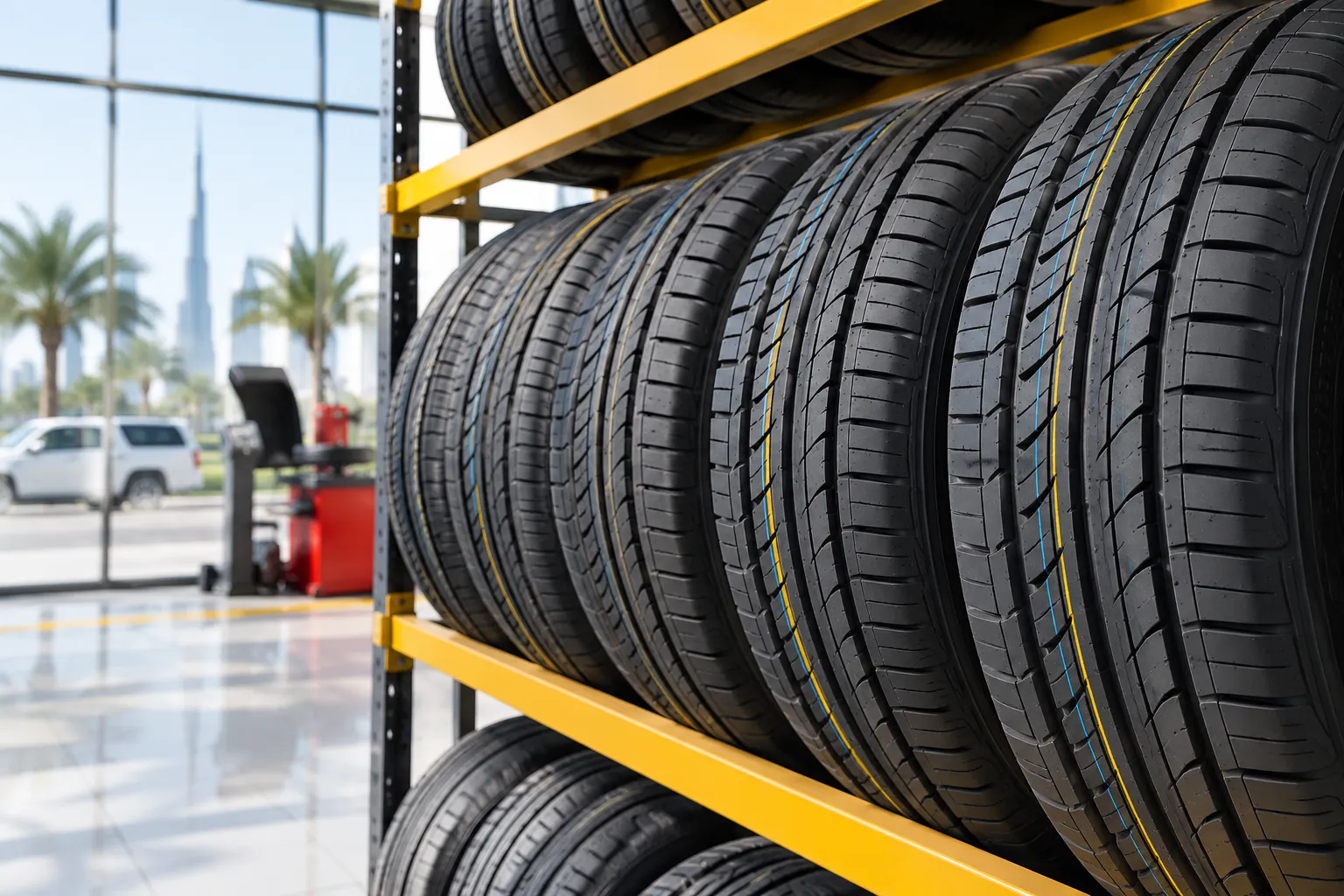
You get a budget, mid-range and premium option in the exact size, each with its manufacture date stated up front, so you know you are not buying old stock.
- 03
Remove and inspect the rims
The old tyres come off and we check the rim bead seats for corrosion, kerb damage or bends that would cause slow leaks on the new tyre.
- 04
Fit, valve and balance
New valves go in, the tyres are mounted with bead lubricant, seated, and every wheel is balanced on a computer balancer with weights matched to your rim type.
- 05
Torque and pressure
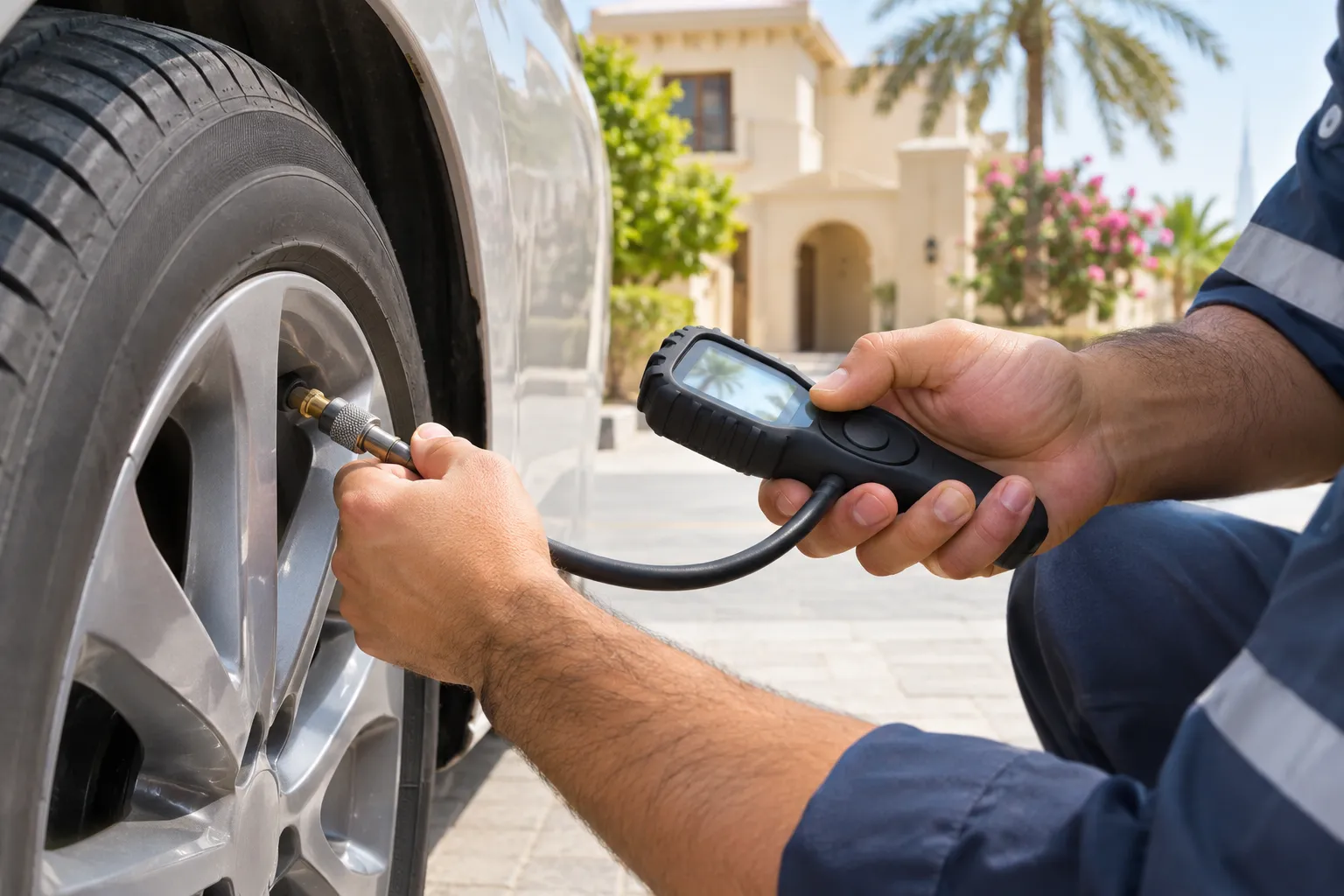
Wheel nuts are tightened in a star pattern to the manufacturer's torque with a torque wrench, and pressures are set cold to the placard figure.
When does a tyre actually need replacing?
There are three separate limits, and a tyre is finished when it hits any one of them. The first is tread depth. The legal minimum is 1.6 mm, which is where the small raised wear bars inside the main grooves sit. In practice wet-road grip drops off well before that, and on a summer storm day on Al Khail Road you will feel it. We suggest planning a replacement at around 3 mm.
The second limit is age. Rubber oxidises and hardens over time whether the car is driven or not, and UAE heat speeds that up. The four-digit DOT code on the sidewall gives the week and year of manufacture (for example 2223 means week 22 of 2023). Five years from that date is the practical limit we work to here, and our article on reading the DOT code shows where to find it.
The third limit is damage. A bulge in the sidewall, a cut that reaches the cords, or a puncture outside the repairable zone of the tread all mean the tyre is done, even if the tread is new.
- Tread at 3 mm: start planning
- Tread at 1.6 mm: replace now
- Five years from the DOT date: replace regardless of tread
- Any sidewall bulge or cord damage: replace before driving further
Two tyres or four?
Replacing all four keeps grip, wear and handling even, but it is not always necessary. If two tyres are worn and the other two still have plenty of tread and are under five years old, replacing a pair on the same axle is fine. When you do fit a pair, the new tyres should normally go on the rear axle. Rear grip is what keeps the car stable when braking hard into a bend or swerving on a wet road; a car with more grip at the front than the back is the one that spins.
All-wheel-drive cars are stricter. Many AWD systems tolerate only a small difference in tread depth between axles before the centre coupling starts working constantly and overheating, so a single new tyre on a worn set can cause expensive damage. On AWD SUVs we measure all four and tell you honestly whether a pair will do or whether the manufacturer expects a full set.
Matching the right tyre to the car
The size on the sidewall is only part of the match. Load index and speed rating must be equal to or higher than the original fitment, which matters on heavy SUVs like the Land Cruiser and Patrol where an undersized load index is a real safety issue. Run-flat cars such as many BMW models usually have no spare wheel, so swapping to standard tyres needs a plan for the next puncture.
Brand choice is where most of the price difference lives. Premium names like Michelin or Bridgestone hold up better to heat and give quieter, more consistent wet grip; mid-range and budget lines can be excellent value for a city car doing short runs. Browse the tyre brands we fit or ask us for current prices in your size before you decide.
Replacement at home or in a basement
Most customers in towers and villa communities book a van rather than coming to Al Quoz. The van carries a tyre changer, balancer, compressor and torque wrench, so the job is the same as in the workshop. In basements we need about one metre of clear space on the working side of the car and a level floor; in villa driveways a flat surface is enough. If you prefer we come to you, the tyre change at home service page covers what to prepare.
Tyre Replacement prices
| Service | Price |
|---|---|
| Fitting only (your tyres), up to 16-inchIncludes balancing and new valve | AED 30–45 per tyre |
| Fitting only, 17-inch and above or run-flat | AED 50–80 per tyre |
| New budget tyre fitted, 14–16-inch | AED 180–320 per tyre |
| New mid-range tyre fitted, 16–18-inch | AED 320–600 per tyre |
| New premium or SUV tyre fittedDepends on size and brand | AED 550–2,200 per tyre |
Prices in AED, including VAT. Final price confirmed before work starts.
Tyre Replacement: questions we get asked
How often should car tyres be replaced in the UAE?
Most cars here need new tyres every 35,000–50,000 km or every four to five years, whichever comes first. Heat ages rubber quickly, so a low-mileage car can still need replacement because of age and sidewall cracking.
What is the tyre replacement cost in Dubai?
Fitting your own tyres costs AED 30–45 per tyre up to 16-inch and AED 50–80 for 17-inch and above or run-flats, including balancing and a new valve. A new budget tyre fitted starts from about AED 180; premium and large SUV tyres range up to AED 2,200 each.
Can I replace just one tyre?
On two-wheel-drive cars, one tyre can be replaced if the others are in good condition and similar in tread depth, ideally fitting the new one alongside a partner on the same axle. On all-wheel-drive cars, check the tread difference first, as a single new tyre can strain the drivetrain.
Do I need a wheel alignment after new tyres?
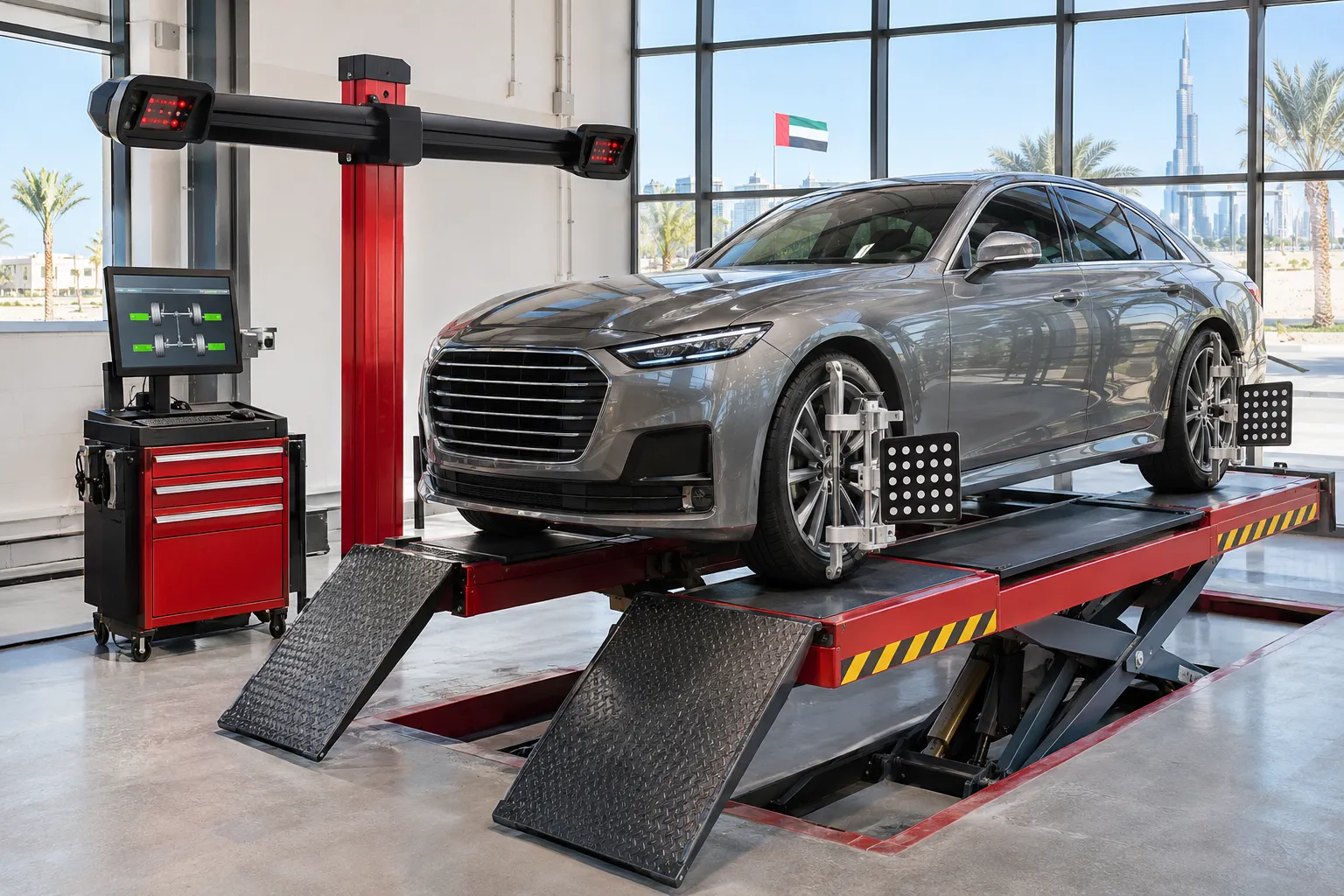
It is not mandatory, but it is the best time to do it. If your old tyres wore unevenly on one edge, the alignment is out and the new tyres will wear the same way. A check with our wheel alignment service protects the investment.
Can you replace tyres at my home or office?
Yes. Our vans cover Dubai, Sharjah and Abu Dhabi, with Ajman on request, and fit tyres in driveways, open parking and most building basements. The price per tyre is the same; a call-out may apply for small jobs.
How old can a new tyre be when I buy it?
A tyre that has been stored correctly is fine at up to about a year old when fitted. We tell you the DOT date of every tyre we quote before you pay, so there are no surprises.