Why tyre care matters more in the UAE
Tyres here work in conditions that would be considered extreme in many countries. Summer asphalt reaches 60–70 °C, cars stand in open car parks all day, sand acts as an abrasive, and speed bumps and basement ramps punish sidewalls daily. All of this shortens tyre life and makes small faults more dangerous.
The good news is that most tyre failures give warning signs. Under-inflation, uneven wear and cracks are easy to spot if you look. A monthly ten-minute check and a few scheduled services prevent the majority of roadside emergencies we attend.
16 tips to keep your tyres okay in the UAE
- 01
Check pressure cold
Every two weeks
Measure before driving, early morning, with a digital gauge, and set to the door placard figure.
Why: Hot readings are misleading; correct cold pressure prevents overheating and uneven wear.
- 02
Inspect tread depth
Monthly
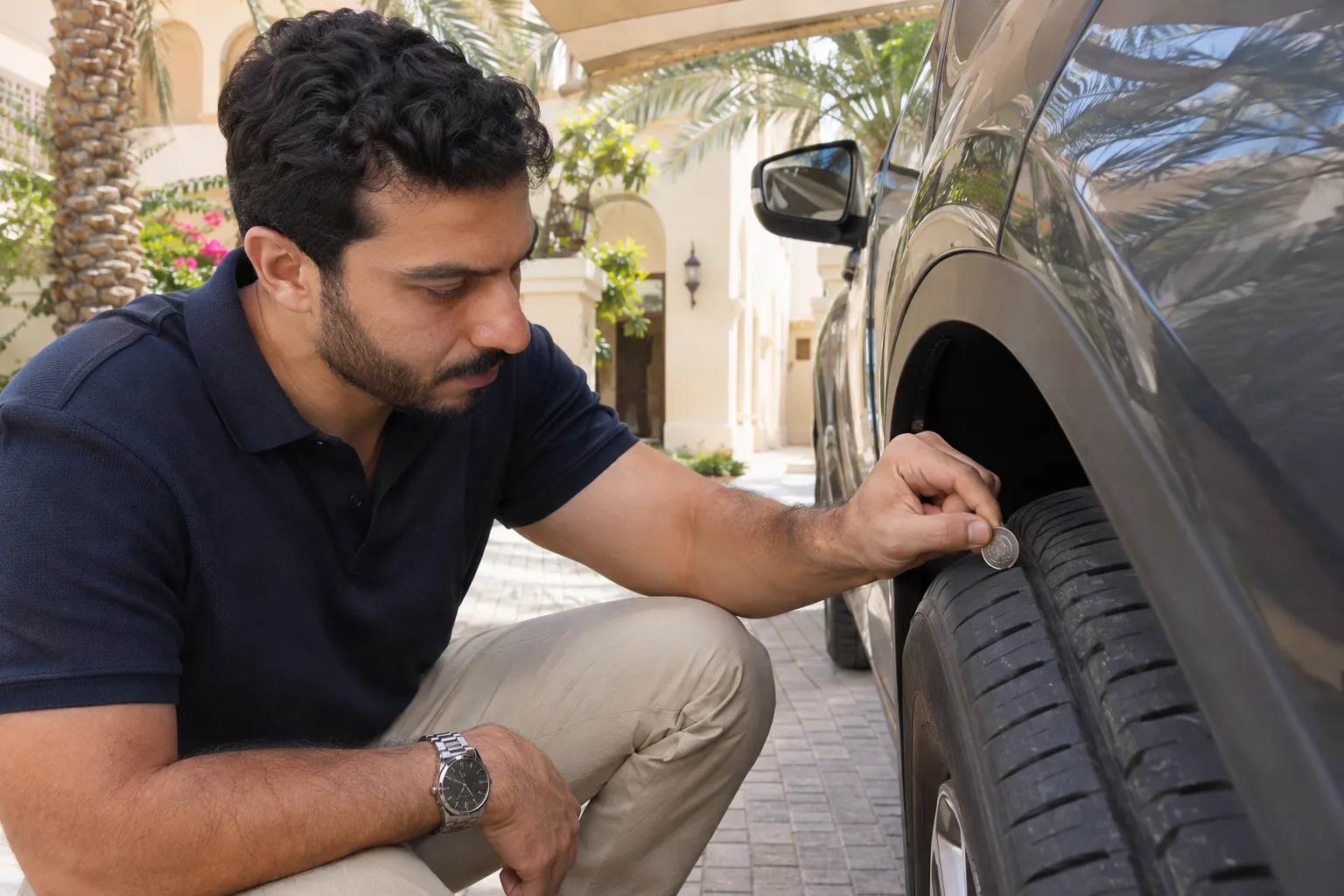
Use a tread gauge or the wear bars in the grooves; replace at 2–3 mm.
Why: Shallow tread loses grip quickly on wet or sandy roads.
- 03
Look for cuts, bulges and nails
Monthly or when washing the car
Walk around the car, turn the steering to see the front tyres fully, and look closely at sidewalls.
Why: Early detection turns a dangerous failure into a simple repair or planned replacement.
- 04
Check the spare
Monthly
Measure its pressure and inspect its age; space-saver spares often need 60 psi.
Why: A flat spare is useless in an emergency.
- 05
Park in shade where possible
Daily
Use covered parking, basement bays or shaded spots; use a cover for long-parked cars.
Why: UV and heat age rubber and cause cracking.
- 06
Rotate tyres
Every 8,000–10,000 km
Swap front and rear according to the pattern for your drive type.
Why: Evens out wear so the set lasts longer and wears out together.
- 07
Check alignment
Every 10,000 km or after an impact
Book an alignment check with a computerised machine.
Why: Misalignment can wear a tyre's edge bald in a few thousand kilometres.
- 08
Balance wheels
At every tyre change or if vibration appears
Have each wheel spun on a balancer and weights corrected.
Why: Unbalanced wheels cause vibration, cupping and wear on suspension parts.
- 09
Avoid overloading
Every trip
Respect the load index and use the loaded pressure figure when carrying heavy loads.
Why: Overload overheats tyres and raises blowout risk.
- 10
Keep valve caps on
Always
Replace missing caps immediately; they cost very little.
Why: Caps keep sand and moisture out of the valve core.
- 11
Slow down for speed bumps and ramps
Every drive
Cross straight and slowly; keep clear of ramp walls.
Why: Impacts cause bulges, rim damage and misalignment.
- 12
Replace tyres by age
At five to six years
Read the DOT code and plan replacement even if the tread looks fine.
Why: Old rubber hardens and cracks in UAE heat.
- 13
Repair punctures properly
When needed
Use an internal patch-plug repair rather than a roadside string plug as a permanent fix.
Why: Proper repairs seal both the hole and inner liner.
- 14
Re-inflate after desert trips
After every off-road trip
Carry a compressor and reinflate to the placard before rejoining the road.
Why: Highway speeds at low pressure overheat sidewalls.
- 15
Keep matching tyres on each axle
When replacing
Fit the same brand, model and size on both sides of an axle.
Why: Mismatched tyres grip differently and can make the car unstable.
- 16
Prepare tyres before travelling
Before long absences
Inflate to the upper placard figure, park in shade and check pressures on return.
Why: Prevents flat spots and dangerous low pressure on the first drive back.
Tyre care schedule
Weekly
- Quick visual check for low or damaged tyres
- Make sure valve caps are in place
Monthly
- Check pressures cold including the spare
- Measure tread depth
- Inspect sidewalls for cracks, cuts and bulges
Every 10,000 km
- Rotate tyres
- Check alignment
- Balance wheels if vibration is felt
Yearly
- Full professional tyre inspection
- Check TPMS sensors
- Replace valves on older wheels
At 5 years
- Plan replacement, regardless of tread depth
- Have tyres inspected closely for ageing and cracks
Building a simple routine
Link tyre checks to something you already do. Check pressures every second Friday morning before the car moves, or every time you fill up in the morning. Look at the tread whenever you wash the car. Book rotation with every oil change, which for most cars falls around every 10,000 km.
Keep a good digital pressure gauge in the glovebox, along with a tread depth gauge. Both cost little and are far more accurate than relying on fuel-station equipment. If you prefer, our tyre inspection covers everything in one visit.
Summer versus winter: what changes through the year
From May to September the job is managing heat. Pressures read higher in the afternoon, rubber softens on hot asphalt and any weakness in a tyre is more likely to show itself. This is the season to be strict about checking pressure cold, to avoid long highway runs on tyres you already suspect, and to look closely at any tyre with a repair or a scuffed sidewall. Most of the blowouts we attend on the E11 and E311 happen in these months, and almost all of them involve a tyre that was low, old or already damaged.
From November to March, cooler nights pull pressures down by 2–3 psi compared with summer readings, and TPMS lights come on across the country on the first chilly mornings. A quick top-up to the placard figure fixes it. Winter is also the best time to book rotation, alignment and replacement before the heat returns, because workshops are quieter and you go into summer on a fresh, correctly set-up set of tyres.
Rain is rare but worth preparing for. The first downpour of the season lifts oil and fine sand off the road surface, and tyres with shallow tread lose grip quickly. If your tread is close to 3 mm by October, replace before the winter rain rather than after it.
Caring for a car that is parked more than it is driven
Many cars in the UAE spend weeks standing still, during summer travel, between rental contracts or as a second family car. A stationary tyre carries the same load on the same small patch of rubber every hour, while heat dries the compound. The result is flat spots, fine cracking and steady pressure loss of 1–2 psi a month.
Before leaving a car, inflate the tyres to the upper end of the placard range, park in a covered or basement bay if you can, and use a sun cover if not. If a friend or driver can move the car a metre or two every week, the load shifts to a fresh part of the tread. When you return, check all four tyres cold before driving anywhere fast, and listen for vibration on the first drive.
Driving habits that protect your tyres
Take speed bumps at walking pace and straight on; angled crossings twist the tyre against the rim. Approach basement ramps slowly and keep clear of the walls. Avoid hard braking and fast cornering on hot days, which scrub rubber off quickly.
Keep away from the road edge on highways, where debris collects. If you see construction material or scrap on the road ahead, change lanes early and safely. Avoid parking against high kerbs, which scuff sidewalls.
If you drive in the desert, lower pressures gradually, avoid sharp turns at low pressure and re-inflate before returning to tarmac. Our guide to desert driving tyres has more.
Knowing when to replace
Replace a tyre when tread drops to 2–3 mm, when the sidewall shows bulges, deep cracks or exposed cords, or when the tyre is around five to six years old. The legal minimum tread in the UAE is 1.6 mm, but wet grip is badly reduced well before that. Read the four-digit date code with our DOT code guide, and check UAE tyre rules and fines to stay legal.
Replace tyres in pairs at least, ideally all four, and put the newer pair on the rear axle unless your car maker says otherwise. Our tyre replacement service includes fitting, balancing and new valves.
Frequently asked questions
How often should I check my tyres in the UAE?
Check pressure every two weeks and do a visual check monthly. Heat makes regular checks more important here than in cooler climates.
How long do tyres last in the UAE?
Typically 40,000–60,000 km or about five years, whichever comes first, depending on driving and parking. See how long tyres last in the UAE.
Does parking in the sun damage tyres?
Yes. UV and heat age rubber faster, causing cracks. Park in shade whenever possible.
Is tyre rotation really necessary?
Yes. It evens out wear between front and rear, so the set lasts longer. A tyre rotation every 10,000 km is a good habit.
What is the minimum legal tread depth in the UAE?
1.6 mm, but grip falls sharply below 3 mm, so we recommend replacing earlier.