Buying Tyres
How Long Do Tyres Last in the UAE? Age, Tread and Km
How long tyres last in the UAE: the 5-year age guideline, the 1.6 mm legal tread minimum, realistic kilometre figures and what wears tyres out faster here.
In the UAE most car tyres last 40,000–60,000 km or around three to four years of normal driving, whichever comes first. Two hard limits apply regardless of how they look: replace any tyre that’s worn to 1.6 mm of tread, the legal minimum, and any tyre that has reached five years from its manufacture date, the age guideline used here.
I think of every tyre as having two clocks running at once. One counts kilometres through tread wear; the other counts years through rubber ageing. Whichever runs out first decides when the tyre comes off.
Key takeaways
- Legal minimum tread in the UAE is 1.6 mm. We advise replacing at about 3 mm.
- The UAE age guideline is five years from the DOT manufacture date, used or unused.
- Heat, sun and under-inflation age tyres faster here than in cooler countries.
- Low-mileage cars usually hit the age limit before the tread limit.
- Rotation every 8,000–10,000 km and correct alignment add thousands of kilometres.
Clock one: tread depth
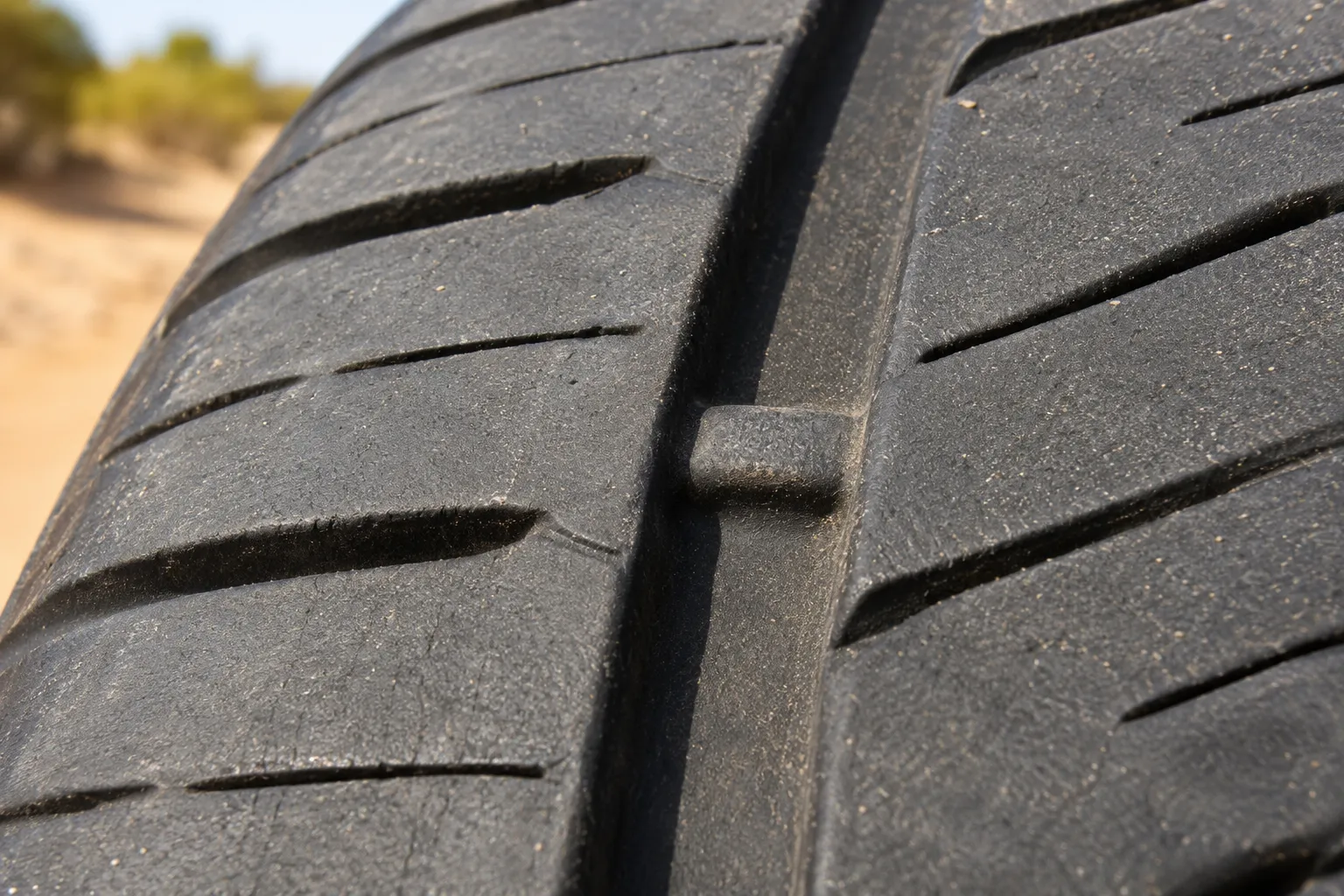
A new car tyre starts with roughly 7–9 mm of tread. Each groove has small raised bars, the tread wear indicators, sitting at 1.6 mm. When the tread surface is level with those bars, the tyre is legally finished.
Why we don’t wait for 1.6 mm
Grip doesn’t fall off at a cliff; it drops gradually. Below about 3 mm a tyre clears water far less effectively. That matters on the few rainy days each winter when Dubai roads are slick with oil and sand, and it matters in emergency braking on any day. A tyre at 2 mm also has very little rubber left to protect the belts from screws and debris, which is why puncture call-outs rise on worn tyres.
How to measure it yourself
- Buy a cheap tread depth gauge, or use the indicator bars.
- Measure in the inner, middle and outer grooves of each tyre.
- Take readings at two or three points around the tyre.
- Write down the lowest figure. That’s the tyre’s true depth.
If the inner edge reads much lower than the outer, you have an alignment problem as well as a tyre problem. My article on signs you need wheel alignment explains what the wear patterns mean.
Clock two: age
Rubber contains oils and anti-ageing chemicals that slowly break down with heat, oxygen and UV light. The tyre gets harder, grips less and eventually cracks, first in the sidewall and between the tread blocks, then deeper. In the UAE’s climate this happens faster than in Europe, which is one reason the five-year guideline exists here.
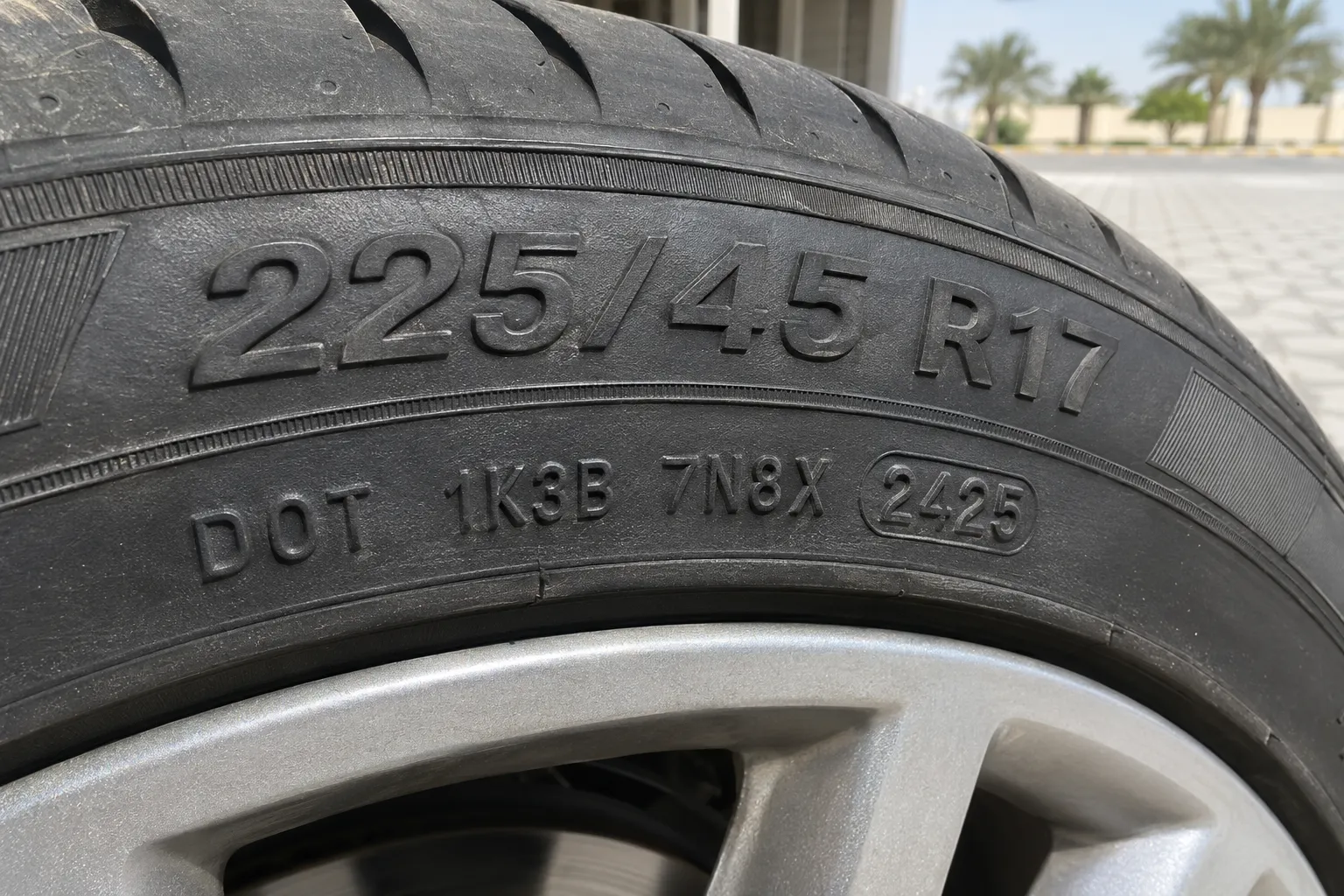
You’ll find the manufacture date in the DOT code: four digits such as 0924, meaning week 9 of 2024. That tyre reaches five years in early 2029. I’ve put a full walkthrough with photos in our guide to the tyre DOT date code.
Age counts from manufacture, not fitting
A tyre that sat in a warehouse for a year before you bought it has already used a year of its life. When buying, ask to see the DOT code before the tyre goes on. We show customers the date on every tyre we fit.
Realistic kilometre figures for the UAE
These are based on what I see on cars that come back to us, with correct pressures and average driving:
| Tyre type | Typical life in the UAE |
|---|---|
| Budget passenger (14–16”) | 25,000–40,000 km |
| Mid-range passenger (16–18”) | 35,000–50,000 km |
| Premium touring (17–20”) | 45,000–65,000 km |
| High-performance / ultra-high-performance | 20,000–35,000 km |
| SUV highway terrain | 45,000–70,000 km |
| SUV all-terrain used on sand | 35,000–55,000 km |
| Run-flat | Often 10–20% less than an equivalent standard tyre |
A taxi or delivery car driving 60,000 km a year will wear tyres out in under a year. A weekend car in a basement in Dubai Marina might do 6,000 km a year and reach the five-year limit with 5 mm of tread left.
What shortens tyre life here
Ranked roughly from biggest to smallest effect, based on what we see:
- Under-inflation. It wears both edges, overheats the casing and causes most summer failures. Check monthly, every two weeks in summer.
- Misalignment. A small toe error can scrub off the inner edge in 10,000 km. Speed bumps and kerbs knock alignment out.
- Sun exposure. Cars parked outdoors in Sharjah or Abu Dhabi without shade age visibly faster. Sidewall cracking on three-year-old tyres is common.
- Heat plus speed. Long runs at 140 km/h on a 45 °C afternoon put a lot of heat into the tread.
- Driving style. Hard launches, fast cornering on cloverleaf ramps and late braking all scrub rubber.
- No rotation. Front tyres on a front-wheel-drive car wear faster. Rotating evens it out. See our tyre rotation service.
- Overloading. Heavy loads on tyres with too low a load index wear the shoulders and build heat.
Does the brand make a difference?
Yes, but less than most people expect. A premium tyre from a well-known maker usually uses a harder-wearing compound and better heat resistance, and on the same car it will often outlast a budget tyre by 10,000 km or more. But a premium tyre run 6 psi low with bad toe will still be finished in two years. Maintenance moves the number more than the badge does.
Where brand matters most is age resistance. Cheaper tyres parked in the sun tend to show sidewall cracking earlier. If your car lives outdoors, that’s a reason to spend a little more. Our best tyre brands in the UAE article compares the options by budget.
Signs a tyre should go before either clock runs out
Some tyres need replacing early, whatever their age or depth:
- A bulge or bubble on the sidewall
- Cuts deep enough to show cords
- Cracks you can fit a fingernail into
- A puncture outside the repairable area
- Damage from being driven flat
- Separation, wobbling or a vibration that balancing doesn’t fix
Our page on common causes of tyre damage shows what each of these looks like.
Three typical cars, three different answers
The same tyre can last very different times depending on the car’s life. These are composites of the kinds of vehicles we see every month:
The commuter sedan. A Corolla driving Sharjah to Dubai and back every weekday, about 30,000 km a year. Mid-range tyres reach 3 mm of tread in roughly 18 months. The tread clock runs out long before the age clock.
The weekend SUV. A Prado that does school runs during the week and a desert trip once a month, 15,000 km a year. Tread lasts three to four years, but sand driving, low pressures off-road and speed bumps add shoulder wear, so we see these at around year three, often with alignment issues as well.
The garage car. A sports coupe in a Downtown basement covering 5,000 km a year. After five years it might still show 5 mm of tread, but the date code says it’s time. These owners are often surprised, and they’re the ones most at risk, because the tyres look new.
Work out which of these is closest to yours and you’ll know which clock to watch.
The cost of running tyres too long
Stretching worn tyres for another few months saves less than it seems. Stopping distances grow as tread drops, punctures get more common, and a blowout can damage the wheel, the arch liner and the bodywork. A tyre inspection costs very little next to any of that.
How to make tyres last longer
None of this is complicated:
- Keep pressures at the placard figure, measured cold.
- Rotate every 8,000–10,000 km, or at every second service.
- Get the alignment checked once a year and after any hard kerb or pothole hit.
- Park in shade or use a cover if the car sits outside for long periods.
- Drive smoothly; the tyres will thank you, and so will your fuel bill.
- Store spare wheels out of direct sun.
Our tyre care tips page goes further into routines for daily drivers and weekend cars.
When it’s time to replace
If either clock has run out, or you’re close, compare options by size and budget. New tyres fitted with us start from AED 180–320 for budget 14–16” sizes, AED 320–600 for mid-range 16–18” and AED 550–1,500 for premium 17–20”. Book tyre replacement at the workshop or at home, and we’ll check the DOT dates on the new tyres in front of you before fitting.
Frequently asked questions
How many kilometres do tyres last in Dubai?
Most mid-range and premium car tyres give 40,000–60,000 km in UAE conditions, budget tyres often 25,000–40,000 km. Heat, under-inflation, poor alignment and hard driving can cut those numbers sharply.
Do tyres expire in the UAE even if they have tread left?
Yes. The UAE guideline treats a tyre as reaching the end of its usable life five years from its manufacture date, shown by the four-digit DOT code on the sidewall, regardless of how much tread is left.
What is the minimum legal tread depth in the UAE?
1.6 mm across the main grooves. Most technicians, including us, recommend replacing at around 3 mm because wet and emergency braking grip drops off well before the legal limit.
Should I replace all four tyres at once?
Ideally, on 4WD and AWD cars, yes. On two-wheel-drive cars you can replace in pairs, with the new pair fitted on the rear axle for stability.
About the author
Fazir Kamal — Fazir Kamal is a tyre technician with five years of hands-on work on UAE roads — roadside punctures on Sheikh Zayed Road at 2 a.m., run-flat fitments in DIFC basements, alignment on desert-driven Patrols. He writes and reviews the technical guides on TyrePuncture.ae.