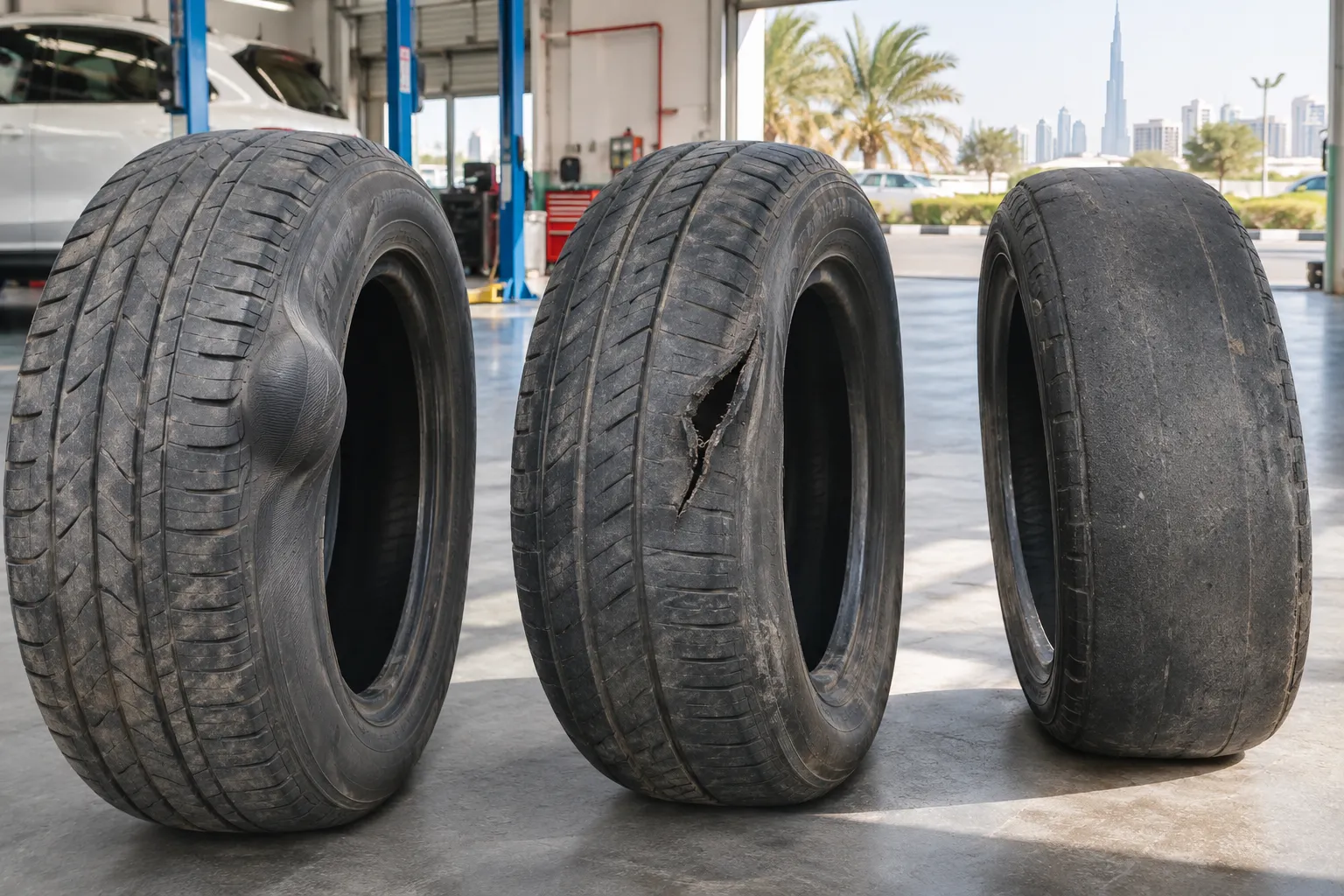
Repairable or not: the basic rules
A puncture can be repaired if it is in the central tread area, roughly the middle three-quarters of the tread width, and the hole is no more than about 6 mm across. The tyre must not have been driven flat, and the inner liner must be undamaged. A proper repair uses a combined patch-plug fitted from the inside after the tyre is removed from the rim. Our page on whether a punctured tyre can be repaired covers the rules in detail.
Damage to the sidewall or shoulder cannot be repaired safely. The sidewall flexes with every rotation, and a patch cannot hold the cord structure together. The same applies to bulges, cuts showing cords, and tyres that have been driven on while flat, which grinds the inner sidewall.
When in doubt, have the tyre removed and inspected from the inside. Many tyres that look fine from outside have hidden damage after being driven flat for even a short distance.
Diagnose by wear pattern
- Both edges wornRunning under-inflated
- Centre wornOver-inflated
- One edge wornCamber / toe out of alignment
- Cupped / patchyUnbalanced wheel or worn shocks
- Feathered ribsToe setting out
- Cracks in rubberHeat and age — over 5 years
14 causes of tyre damage, and whether they can be fixed
Nail or screw punctureRepairable: Sometimes
Symptoms
- Slow pressure loss over days
- Visible nail or screw head in the tread
- TPMS warning light
- Hissing when soapy water is applied
Why it happens
Construction sites, industrial areas and delivery routes leave screws and nails on the road; they are picked up by the tread and work in over time.
Prevention
Avoid driving through construction debris, check tread monthly, and keep pressure correct so the tread resists penetration.
See the fixSidewall cutRepairable: No
Symptoms
- Visible gash in the side of the tyre
- Exposed cords or fabric
- Rapid air loss in deep cuts
Why it happens
Sharp kerb edges, broken glass, scrap metal and rocks slice into the thin sidewall, which has no steel belt protection.
Prevention
Park away from sharp kerb edges, avoid scraping during parallel parking, and take basement ramps slowly.
See the fixBulge or impact breakRepairable: No
Symptoms
- Bubble or lump on the sidewall
- Vibration at speed
- Visible after hitting a pothole or kerb
Why it happens
A hard impact pinches the tyre against the rim and breaks the internal cords; air pressure then pushes the rubber outward.
Prevention
Slow down for speed bumps and potholes, keep correct pressure, and avoid hitting kerbs.
See the fixUnder-inflation shoulder wearRepairable: No
Symptoms
- Both outer edges worn more than centre
- Sluggish steering
- Tyre looks squat
Why it happens
Low pressure lets the tyre sag so the shoulders carry the load, which overheats and wears them.
Prevention
Check pressure cold every two weeks and set it to the placard figure.
See the fixOver-inflation centre wearRepairable: No
Symptoms
- Centre of tread worn more than edges
- Harsh ride
- Reduced grip on wet roads
Why it happens
Too much pressure makes the tread bulge in the middle, so only the centre strip contacts the road.
Prevention
Inflate to the placard figure, not the sidewall maximum, and never set pressure when tyres are hot.
See the fixMisalignment (feathering or inner-edge wear)Repairable: No
Symptoms
- Inner or outer edge worn bald
- Feathered tread blocks
- Car pulls to one side
- Steering wheel off-centre
Why it happens
Impacts with potholes, kerbs and speed bumps shift toe and camber, so the tyre scrubs sideways as it rolls.
Prevention
Have alignment checked every 10,000 km or after any hard impact.
See the fixUnbalanced wheels and cuppingRepairable: No
Symptoms
- Scalloped patches around the tread
- Vibration at 80–120 km/h
- Humming noise
Why it happens
An unbalanced wheel or worn shock absorber makes the tyre bounce, scuffing patches of tread.
Prevention
Balance wheels at every tyre change and when vibration appears; inspect shock absorbers.
See the fixHeat ageing and crackingRepairable: No
Symptoms
- Fine cracks on sidewalls or between tread blocks
- Hard, shiny rubber
- Tyre over five years old
Why it happens
High temperatures and UV light break down the rubber compounds, making them brittle.
Prevention
Park in shade, use covers for long-parked cars, and replace tyres at five to six years old.
See the fixDry rot and flat spots from long parkingRepairable: No
Symptoms
- Deep cracks after car stood for months
- Vibration on first drive
- Low pressure on return from travel
Why it happens
A stationary car puts constant load on one area of each tyre while heat dries the rubber.
Prevention
Inflate to the upper placard figure before leaving the car, park in shade and move it periodically.
See the fixBead damageRepairable: Sometimes
Symptoms
- Slow leak around the rim
- Tyre will not seat properly
- Visible tears at the bead
Why it happens
Poor fitting technique, sand or corrosion on the rim, or driving on a flat tyre damages the bead that seals against the rim.
Prevention
Use a careful fitter who cleans and lubricates the bead seat, and never drive on a flat.
See the fixValve failureRepairable: Yes
Symptoms
- Slow leak with no puncture
- Cracked rubber valve stem
- Missing valve cap
Why it happens
Rubber valve stems crack in heat, and sand gets into valve cores if caps are missing.
Prevention
Replace valves at every tyre change and keep caps fitted.
See the fixRim and kerb damageRepairable: Sometimes
Symptoms
- Scraped or bent rim edge
- Slow leak at the bead
- Vibration after hitting a kerb
Why it happens
Kerb strikes and potholes bend or crack alloy rims, breaking the seal with the tyre.
Prevention
Take care when parking near kerbs and avoid potholes; low-profile tyres offer little protection.
See the fixSand and desert driving damageRepairable: Sometimes
Symptoms
- Tyre unseated from rim
- Cuts from rocks or thorns
- Sand inside the tyre
Why it happens
Low pressures in soft sand plus sharp turns can unseat the bead; rocks and thorns hidden under sand cut the tread.
Prevention
Use all-terrain tyres, deflate gradually, avoid sharp turns at low pressure, and re-inflate before the road.
See the fixOverloadingRepairable: No
Symptoms
- Sidewall bulging outward under load
- Overheated tyre
- Rapid wear on pickups and vans
Why it happens
Carrying more than the load index allows overstresses the casing and builds heat.
Prevention
Respect the load index and use the loaded pressure figure on the placard.
See the fixWear patterns tell you what is wrong
The way a tyre wears is a diagnostic tool. Wear on both shoulders points to under-inflation. Wear in the centre points to over-inflation. Wear on one edge, usually the inner one, points to camber or toe misalignment. Cupped or scalloped patches point to worn shocks or unbalanced wheels.
Check the tread across its full width once a month. Run your palm across it from inside to outside: if it feels smooth one way and rough the other, the tread is feathering, a classic toe-alignment problem. Catching it early saves the rest of the tyre, and our wheel alignment check takes about 45 minutes.
Heat and the UAE sun
Asphalt in the UAE regularly reaches 60–70 °C in summer, and a car parked in the open can see tyre sidewalls hotter still. Heat speeds up the chemical ageing of rubber, which loses flexibility and develops fine cracks. Ultraviolet light adds to the damage, especially on the side of the car facing the sun all day.
Heat also turns small problems into big ones. An under-inflated tyre, an old repair or a hidden impact break can hold for months in winter, then fail on a hot highway run in July. That is why most blowouts here happen between June and September; our summer blowouts article covers the pattern.
What to do when you find damage
If the tyre is losing air quickly, has a bulge, or you hear a thumping sound, stop as soon as it is safe and do not drive further. Driving on a flat tyre for even a few hundred metres usually destroys it. Use your spare or call for roadside flat tyre help.
If the tyre is holding air and the damage is a nail or screw in the tread, leave the object in place and drive gently to a repair. Pulling it out turns a slow leak into a flat.
For anything else, such as cracks, odd wear, or a tyre that keeps losing pressure, book an inspection. A careful look under good light catches most problems before they become dangerous.
Frequently asked questions
Can a tyre with a nail be repaired?
Usually yes, if the nail is in the central tread, the hole is under about 6 mm and the tyre has not been driven flat. Shoulder and sidewall punctures cannot be repaired safely.
Is a sidewall bulge dangerous?
Yes. It means the internal cords are broken and the tyre can fail without warning. Replace it as soon as possible; see our sidewall bulge guide.
Why are my tyres cracking even though the tread is fine?
Heat and UV age the rubber in the UAE. If the cracks are deep or the tyre is over five years old, it should be replaced.
What causes uneven tyre wear?
Wrong pressure, misalignment and unbalanced wheels. The wear pattern shows which; a quick inspection identifies the cause.
Can I drive on a tyre with a slow leak?
Short distances, after topping up, to get it repaired. Keep checking pressure, because a slow leak can become a fast one.