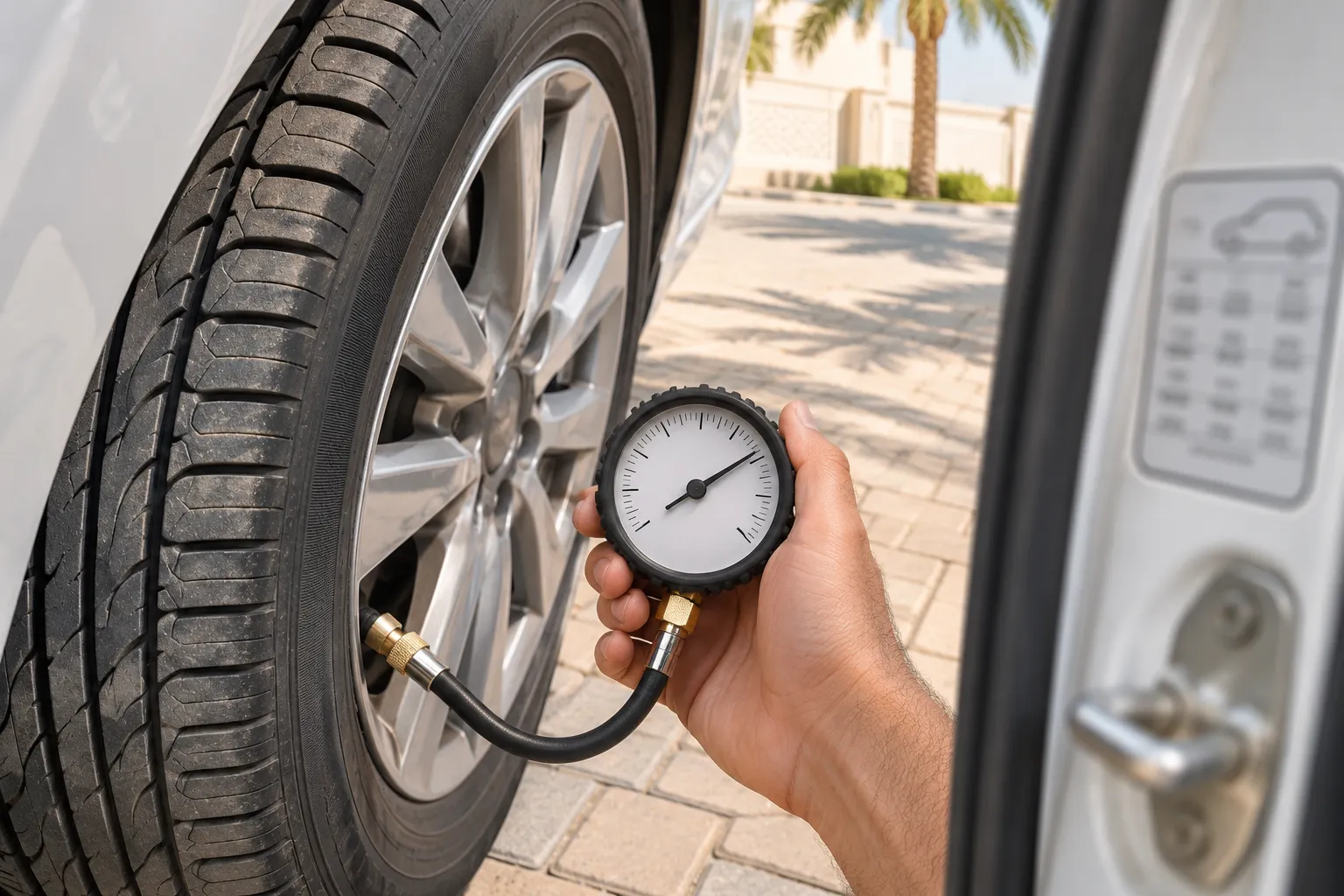
Where to find the correct pressure for your car
Every car sold in the UAE carries a tyre placard, usually a sticker on the driver's door jamb. Some makes put it inside the fuel flap or the glovebox lid. It lists the front and rear pressure for normal driving and, on many cars, a second set for full load or sustained high speed. Those figures were set by the car maker for that exact model, tyre size and weight, so they beat any generic chart, including the one on this page.
Ignore the number moulded into the tyre sidewall. That is the maximum pressure the tyre can hold, often 44 or 51 psi, not the pressure you should run. Inflating to the sidewall maximum gives a hard, skittish ride and less grip, especially on wet roads after one of our rare winter storms.
If you have changed to a different tyre size, for example plus-sized alloys on a Patrol or a Camry, the placard may no longer be exact. In that case ask the fitter to calculate an equivalent pressure based on load index, or bring the car in for a free tyre pressure check and we will set it for you.
What pressure does to the tyre
Cross-section on the road (top) and the footprint it leaves (bottom). Darker areas wear fastest.
| Under-inflated | Correct | Over-inflated | |
|---|---|---|---|
| Contact patch | Footprint widens and the centre lifts; load sits on the shoulders. | Even footprint across the full tread width. | Footprint shrinks and bulges at the centre. |
| Wear | Both outer edges wear fast; casing flexes and heats up. | Even wear; tyre reaches its designed lifespan. | Centre of the tread wears faster than the edges. |
| Handling | Slow, vague steering; longer braking; higher blowout risk in summer. | Predictable steering and braking as the car maker intended. | Harsh ride, less grip, especially on wet or sandy roads; more vulnerable to pothole impacts. |
| Fuel | Rolling resistance rises; around 1–3% more fuel at 20% low. | Optimal rolling resistance for the tyre and vehicle. | Marginally lower consumption, but not worth the lost grip. |
Heat and pressure in a UAE summer
Air pressure rises by roughly 1 psi for every 5–6 °C increase in tyre temperature. In the UAE, a tyre set to 33 psi in a cool basement at 25 °C can read 36–38 psi after driving on 60 °C summer asphalt. That is normal, and the placard allows for it. Always measure and adjust cold, ideally early in the morning before the car has moved, and never release air from a hot tyre to match the cold figure.
Typical tyre pressures by vehicle
Starting points only — the placard on your driver's door jamb (or fuel flap) is the figure to follow.
| Vehicle | Front (psi) | Rear (psi) | Fully loaded |
|---|---|---|---|
| Small hatchback / compact sedan (Nissan Sunny, Toyota Yaris, Kia Picanto) | 32–35 psi | 30–33 psi | 35–36 psi |
| Mid-size sedan (Toyota Camry, Nissan Altima, Hyundai Sonata) | 33–36 psi | 33–36 psi | 35–38 psi |
| Premium sedan (Mercedes E-Class, BMW 5 Series, Lexus ES) | 32–38 psi | 35–42 psi | 38–45 psi rear |
| Compact SUV (Toyota RAV4, Nissan X-Trail, Hyundai Tucson) | 33–36 psi | 33–36 psi | 36–38 psi |
| Large SUV (Toyota Land Cruiser, Nissan Patrol, Chevrolet Tahoe) | 30–35 psi | 30–35 psi | 35–41 psi rear |
| Pickup (Toyota Hilux, Nissan Navara, Ford F-150) | 29–35 psi | 29–35 psi | 35–45 psi rear |
| 7-seat MPV (Toyota Innova, Kia Carnival) | 33–36 psi | 33–38 psi | 38–42 psi |
| Sports / performance car (Porsche 911, Ford Mustang) | 32–36 psi | 35–42 psi | Per placard (high-speed figure) |
| Electric car (Tesla Model 3/Y, MG4) | 36–42 psi | 36–42 psi | 42 psi |
| Light van (Toyota Hiace, Nissan Urvan) | 37–45 psi | 40–50 psi | 45–65 psi rear (LT tyres) |
Why you must check tyre pressure cold
Pressure rises as air warms. A tyre that reads 33 psi at 6 a.m. in a basement can read 37–38 psi after a 20-minute drive on a July afternoon, when the asphalt is at 60–70 °C. Placard figures are always cold figures, meaning the car has stood for at least three hours or been driven less than about 2 km.
The classic UAE mistake is topping up at a fuel station after driving across town in the afternoon. The gauge reads low compared with what you expected, or you set the hot tyre to the cold figure. By the next morning the tyre has cooled and is 3–5 psi under. Repeat that for a few weeks and you have a set of tyres wearing on the shoulders and running hot on the highway.
Never let air out of a hot tyre to bring it down to the placard figure. The reading will drop well below the correct pressure once the tyre cools. If you must check after driving, add 3–4 psi to the cold target as a rough guide and recheck the next morning.
- Check first thing in the morning, before driving, at least every two weeks.
- Use your own digital gauge; fuel-station gauges are often off by 2–3 psi.
- Include the spare, which is usually forgotten until the day it is needed.
- Re-check after any big temperature swing, such as the first hot week of May.
Summer, winter and the desert: adjusting for UAE conditions
You do not need to lower pressure for summer. The placard already accounts for normal heat build-up. What changes in summer is how fast an under-inflated tyre overheats. A tyre that is 20% low flexes far more, and at 120 km/h on the E11 in August that extra flexing can push the internal temperature high enough to separate the tread. Our article on why tyres burst in summer explains the mechanism.
In winter, overnight temperatures drop to the mid-teens in parts of the country, and cold-morning readings fall by 2–3 psi compared with summer. That is when TPMS warning lights come on across the city. Top up to the placard figure and the light should go out after a short drive.
Desert driving is the one time to deliberately run low. Dropping to around 15–18 psi lengthens the footprint so the tyre floats on soft sand. Re-inflate before you rejoin the tarmac, because highway speeds at desert pressure destroy sidewalls. Read more in our guide to tyres for desert driving.
Loaded cars, towing and long road trips
Seven seats full, a roof box and luggage for a weekend in Hatta or Fujairah can add several hundred kilograms. That is what the higher "full load" figure on the placard is for. Most cars want 3–6 psi more at the rear when loaded; some pickups and vans need considerably more.
Towing a boat or caravan puts extra weight on the rear axle of the towing vehicle. Use the loaded figure and check the trailer's own tyres, which are often forgotten in a corner of the driveway for months and can be cracked with age.
After the trip, drop back to the normal figure. Running full-load pressure every day gives a firmer ride and wears the centre of the tread faster.
Nitrogen, TPMS and pressure loss
All tyres lose some air naturally, roughly 1–2 psi a month. Nitrogen molecules pass through rubber more slowly than oxygen, so a nitrogen-filled tyre holds pressure a little longer and runs slightly more stable in heat. It is a modest benefit, not a substitute for checking. Our nitrogen vs air comparison covers the details honestly.
Tyre pressure monitoring systems (TPMS) warn when a tyre drops roughly 20–25% below the set value. By then the tyre is already well under-inflated. Treat the light as a last-chance warning, not a schedule. If it stays on after topping up, a sensor battery may be failing; see our TPMS warning light guide.
A tyre that needs topping up every week is not losing air naturally. It has a slow puncture, a leaking valve or a bead leak, and it should be inspected.
Frequently asked questions
What is the correct tyre pressure for most cars in the UAE?
Most sedans and compact SUVs run 32–36 psi, but the correct figure is on the placard inside your driver's door jamb. Use that, measured cold.
Should I reduce tyre pressure in summer?
No. Keep to the placard figure measured cold. Lowering pressure increases flexing and heat, which raises the risk of a blowout.
Is 40 psi too high for my car?
For most petrol sedans and SUVs it is too high for everyday driving, unless the placard says so. Many EVs, such as the Tesla Model 3, are specified around 42 psi.
How often should I check tyre pressure?
At least every two weeks and before any long trip, with the tyres cold. Check the spare once a month.
Why did my TPMS light come on on a cold morning?
Pressure drops as the temperature falls, roughly 1 psi per 5–6 °C. Top up to the placard figure and the light should clear after a short drive.
Do you check tyre pressure for free?
Yes, a pressure check and top-up is free at our Al Quoz workshop, and we set pressures on every mobile visit.