Driving in the UAE
Tyres for Desert Driving in the UAE: Pressures and Picks
Best tyres for UAE dune driving, what pressure to air down to (15–20 psi), how to reinflate before the road, and the tyre damage to check for after a trip.
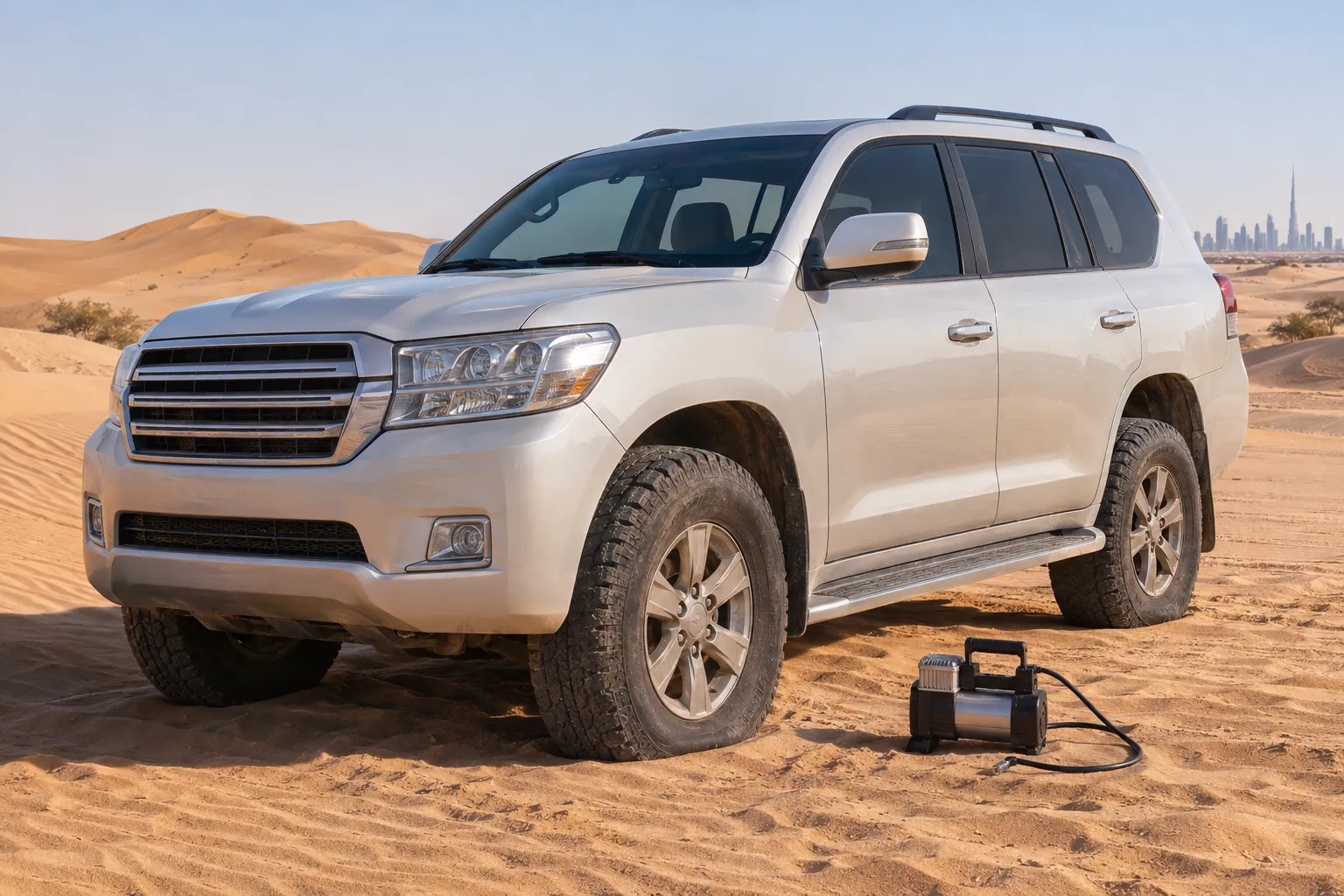
The best tyres for desert driving in the UAE are all-terrain (A/T) tyres with strong sidewalls, but the single biggest factor is pressure: air down to about 15–20 psi before entering soft sand, and reinflate to your normal road pressure before getting back on tarmac. Standard SUV highway tyres can manage a gentle desert trip if aired down correctly; regular dune drivers should step up to a tougher A/T tyre.
Key takeaways
- Lower pressure lengthens the tyre’s footprint so it floats on sand instead of digging in.
- 15–20 psi suits most 4x4s in UAE sand; don’t go much lower on standard rims.
- Keep speed low and turns gentle while aired down to avoid pulling a tyre off the rim.
- Reinflate before the road. Driving at highway speed on low pressure ruins sidewalls.
Why tyre pressure matters more than tread
Most people think a chunky tread is what gets a car through sand. In soft dunes around Al Faya, Big Red and Liwa, the tread does less than you’d expect. What works is the size of the contact patch.
At a road pressure of 33–35 psi, a tyre’s footprint is short and narrow. It acts like a spade and digs down. Drop to 18 psi and the footprint stretches noticeably longer. The car’s weight is spread over a bigger area, the tyre rides on top of the sand, and you need less throttle, so you’re less likely to dig in.
That’s why a correctly aired-down SUV on highway tyres often goes further than a vehicle with aggressive mud tyres pumped to road pressure.
Which tyre type for which driver
| Tyre type | Sand performance | Road manners | Best for |
|---|---|---|---|
| Highway terrain (H/T), standard SUV tyre | Fair when aired down | Quiet, comfortable, best wet grip | Mostly city/highway, occasional easy desert trips |
| All-terrain (A/T) | Very good | Slightly noisier, good in dry | Regular weekend dune drivers, mixed use |
| LT-construction all-terrain | Very good, toughest sidewalls | Firmer ride | Heavy 4x4s, frequent dunes, rocky wadis |
| Mud-terrain (M/T) | Good, but can dig in sand | Noisy, quicker wear on tarmac | Mud and rock, rarely ideal for UAE sand |
| Budget A/T | Variable | Varies | Light use; check sidewall strength closely |
For most people here, a quality A/T tyre is the right compromise. Popular choices we fit include the BFGoodrich All-Terrain T/A, Toyo Open Country A/T, Yokohama Geolandar A/T and Nitto Terra Grappler. Cooper and General Tire offer good A/T options at a lower price. Sizes and prices for common SUVs are on our SUV and 4x4 tyres page.
What to look for on the sidewall
- 3-ply or reinforced sidewall construction: aired-down sidewalls flex a lot and meet the occasional rock or buried branch.
- LT (light truck) rating if your vehicle is heavy or you carry a lot of gear.
- Correct load index. Don’t drop it to save money.
- A fresh DOT date. Desert flexing is hard on old rubber; tyres near the UAE five-year limit are more likely to crack.
Suggested desert pressures
These are starting points from our own trips and customer cars. Always adjust to the sand, the load and how the car feels.
| Situation | Typical pressure | Notes |
|---|---|---|
| Normal road driving | Door-placard figure (often 30–36 psi) | Check cold |
| Hard-packed sand tracks, gravel | 22–25 psi | Some comfort gain, less puncture risk |
| Soft dunes (most UAE dune areas) | 15–20 psi | The usual range for 4x4s |
| Stuck in very soft sand | Down to about 12–14 psi temporarily | Only to recover, at walking speed; reinflate after |
| Light crossover / AWD SUV | 18–20 psi | Less weight; lower ground clearance limits dunes |
Many experienced UAE drivers settle on 15–18 psi for heavy 4x4s like Land Cruisers and Patrols in soft sand. Going below about 15 psi on standard rims without beadlocks raises the risk of a tyre rolling off the bead in a sharp turn.
How to air down and reinflate
Before the sand
- Stop on firm ground at the entry point, away from the access road.
- Check all tyres cold or warm, but note that road-warm tyres will lose a couple more psi as they cool in the sand.
- Deflate evenly, using a tyre deflator or a gauge with a bleed valve. Check each tyre. Don’t guess by eye.
- Lower all four to the same pressure. Mismatched pressures make the car pull and slide.
- Engage 4WD, switch off traction control if your manual recommends it for sand, and keep the speed down.
Driving while aired down
- Keep speed under about 40–50 km/h on tracks.
- Avoid sharp turns at speed and side-slopes taken hard; that’s when tyres come off the rim.
- Don’t spin the wheels when you start to bog. Stop, reverse a little, and go again gently.
Back to the road
- Stop at firm ground before the tarmac. Many dune entry points have a sand area where people reinflate.
- Use a proper 12 V compressor connected directly to the battery, not a weak cigarette-lighter pump.
- Inflate to the door-placard pressure. Remember the tyres will be warm, so aim one or two psi above and re-check cold the next morning.
- Look over every tyre for cuts, bulges or embedded thorns before you drive.
- Don’t skip it. Driving 20 km of highway at 15 psi is a quick way to overheat the sidewall, a scenario I cover in why tyres burst in summer.
If you have no compressor, drive slowly to the nearest petrol station with hazards on, and treat it as the last time you forget it.
How desert driving affects tyre wear on the road
Weekend dune drivers often ask why their tyres wear faster than a friend’s on the same model. A few reasons:
- Repeated deflate and reinflate cycles. Every aired-down trip flexes the sidewall hard. Over a season, that fatigue adds up, especially in the heat.
- Forgetting to reinflate fully. Many drivers pump up to 26–28 psi “to be safe” and then drive at that pressure for a week. That wears the outer shoulders and heats the tyre on the highway.
- Sand in the rims and valves. This causes balance problems and slow leaks that keep the tyre under-inflated.
- Spinning the wheels. Digging out of soft sand with the throttle scrubs tread off the tyre quickly and can cut it on buried debris.
- Mixed-age tyres. Replacing one damaged tyre after a trip leaves a new tyre next to worn ones. On full-time 4x4 systems, a big difference in tread depth between axles can strain the drivetrain. Check your manual for the allowed difference.
For drivers who head out most weekends in winter, I’d suggest checking pressures the morning after every trip, washing out the rims, and getting a tyre rotation every 8,000–10,000 km so all four wear at the same rate.
Desert kit list
| Item | Why |
|---|---|
| 12 V compressor (high flow) | Reinflate four tyres in 15–20 minutes |
| Accurate tyre gauge or deflator | Equal pressures on all four |
| Full-size spare in good condition | A space-saver is useless in sand |
| Tyre plug kit | Quick repairs to tread punctures |
| Shovel and recovery boards | Self-recovery without spinning wheels |
| Recovery strap with rated shackles | For tow-outs by another vehicle |
| Flat board for the jack | Jacks sink in sand |
| Water, phone, a second vehicle | Never go alone into deep dunes |
After the trip: tyre checks
Sand driving is hard on tyres in ways you won’t see on the drive home. After every trip, or at least the morning after, check:
- Sidewalls for bulges or cuts. Aired-down sidewalls are exposed to rocks and roots. A bubble means replace, as explained in our sidewall bulge guide.
- Bead area for sand trapped between tyre and rim, which causes slow leaks.
- Valve stems and caps. Sand in an open valve can cause leaks.
- Wheel balance. Packed sand inside alloy rims throws the balance off and causes vibration at 100–120 km/h. Wash the inside of the rims and, if it persists, book a wheel balancing check.
- Alignment. Hard landings off dune crests can knock the alignment out.
Last winter, after a weekend of busy group trips, I balanced the wheels on eight cars in two days, all with the same complaint: a steering wobble at 110 km/h on the drive home. Every one had a few hundred grams of packed sand inside the rims.
Getting desert-ready tyres fitted
If you’re heading into the dunes this season, start with tyres that are under four years old, a correctly set spare and a working compressor. We stock and fit all-terrain tyres in common SUV sizes at our Al Quoz workshop and at your door across Dubai, Sharjah and Abu Dhabi. Have a look at our new tyres service, or ask us for a pre-trip tyre inspection before your next desert weekend.
Frequently asked questions
What tyre pressure should I use in the desert?
Most 4x4s run well in soft UAE sand at about 15–20 psi. Lighter vehicles can sit at the higher end, very soft dunes may need a little lower, but going far below 15 psi on standard rims increases the risk of the tyre coming off the bead.
Can I drive on the road with deflated tyres after the desert?
Only very slowly for a short distance to reach a compressor. Low pressure on tarmac overheats the sidewalls and can damage the tyre. Reinflate to the door-placard pressure before you drive at normal speed.
Are all-terrain tyres good for daily driving in Dubai?
Modern all-terrain tyres are fine for daily driving. They are a little noisier and use slightly more fuel than road tyres and have longer wet braking distances, but they handle sand and gravel far better.
Do I need special tyres for dune bashing?
Not for an easy first trip with an experienced group; standard SUV tyres work in sand when properly aired down. For regular dune driving, all-terrain tyres with a stronger sidewall and LT construction last longer and resist punctures from rocks and debris.
About the author
Fazir Kamal — Fazir Kamal is a tyre technician with five years of hands-on work on UAE roads — roadside punctures on Sheikh Zayed Road at 2 a.m., run-flat fitments in DIFC basements, alignment on desert-driven Patrols. He writes and reviews the technical guides on TyrePuncture.ae.