Alignment & Balancing
Wheel Balancing vs Alignment: What's the Difference?
Wheel balancing vs alignment explained: what each one fixes, the symptoms that point to each, when you need both, and alignment and balancing prices in Dubai.
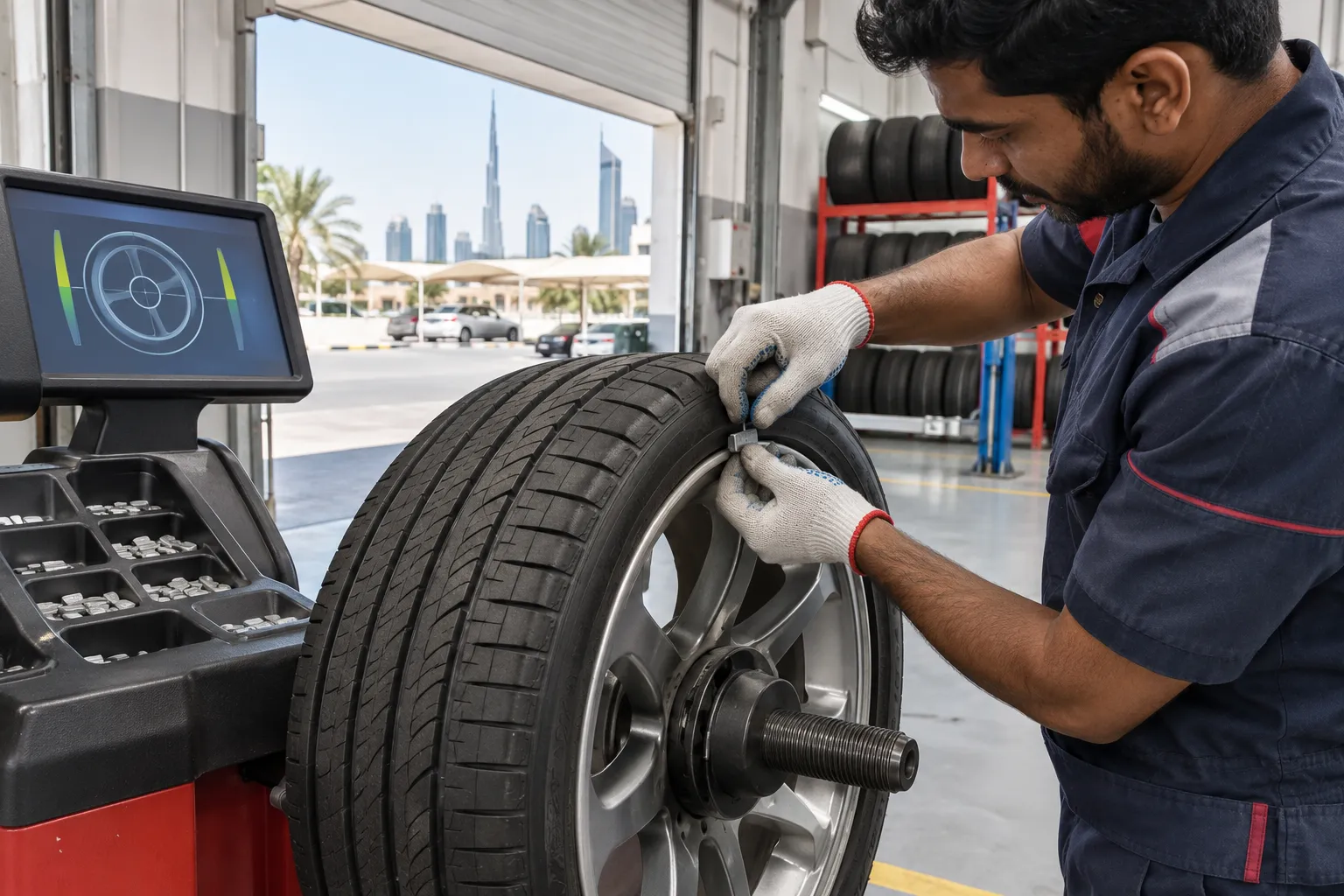
Wheel balancing corrects uneven weight around a wheel and tyre so it spins smoothly; it fixes vibration. Wheel alignment adjusts the angles at which the wheels meet the road; it fixes pulling and uneven tyre wear. They’re different jobs on different machines, and a car can need one, the other or both.
The two get confused all the time, partly because shops often sell them together. Here’s how to tell which one your car is asking for.
Key takeaways
- Balancing = weight. Alignment = angles.
- Vibration at speed points to balancing. Pulling and edge wear point to alignment.
- Balancing is done on each wheel off the car. Alignment is done with the car on a ramp.
- New tyres always need balancing; alignment at the same time is good practice.
- Balancing costs AED 25 per wheel; alignment AED 120–180; both together AED 199–249.
The difference in one table
| Wheel balancing | Wheel alignment | |
|---|---|---|
| What’s corrected | Weight distribution around the wheel and tyre | Toe, camber and caster angles of the suspension |
| Main symptom | Vibration in steering, seat or floor at speed | Pulling, crooked steering wheel, uneven tyre wear |
| How it’s done | Wheel spun on a balancing machine; small weights added to the rim | Car on an alignment ramp; suspension and steering links adjusted |
| Wheels off the car? | Yes | No |
| Time | 30–40 minutes for four wheels | 45–60 minutes |
| When it’s needed | New tyres, puncture repairs, tyre removal, vibration | New tyres, after impacts, suspension work, wear or pulling |
| Price at our workshop | AED 25 per wheel | AED 120 (sedan) – 180 (SUV/4x4) |
Work out what your car needs from the symptom
Start with what you feel or see. This is the same list I go through when a customer phones in.
| What you notice | Most likely | Next most likely |
|---|---|---|
| Steering wheel shakes at 80–120 km/h | Front wheel balance | Bent front rim, tyre bulge |
| Seat or floor vibrates at speed | Rear wheel balance | Rear tyre damage, driveshaft |
| Vibration started straight after a puncture repair | Balance not redone | Repair weight lost |
| Car pulls left or right | Alignment | Low tyre, sticking brake |
| Steering wheel off-centre | Alignment | Recent kerb or speed bump hit |
| Inner or outer tyre edge worn | Alignment | Under- or over-inflation |
| Patchy, cupped wear (scalloped dips) | Balance and worn shock absorbers | Alignment |
| Shudder only when braking | Neither: brake discs | — |
| Wobble at low speed | Tyre damage or loose wheel | Bent rim |
That last row matters: a wobble at walking pace is never a balancing issue. Stop and check the wheel nuts and tyres. Our page on tyre damage causes shows what separated or bulging tyres look like.
What happens during wheel balancing
Every wheel and tyre has slight heavy spots: the valve, the tyre’s joint, variations in the rim. At 120 km/h a 17-inch wheel spins about 16 times a second, and a heavy spot of just 20–30 grams is enough to shake the steering.
In our workshop:
- Remove the wheel and clean old stones out of the tread and mud or sand from inside the rim. Sand caked inside an alloy is a surprisingly common cause of imbalance after desert trips.
- Remove the old weights if needed.
- Mount the wheel on the balancer and enter the rim size.
- Spin it. The machine shows how much weight is needed and where, on both the inner and outer planes (dynamic balance).
- Fit clip-on or adhesive weights at the marked positions. Alloy wheels usually get adhesive weights on the inside so they’re hidden.
- Spin again to confirm it reads zero.
- Refit and torque the nuts in a star pattern.
Balance doesn’t stay perfect forever. Tread wears unevenly, weights fall off after a hard pothole or a jet wash, and sand builds up inside the rim. That’s why a car that was smooth after fitting can develop a shake a year later with no obvious cause; a quick rebalance usually sorts it.
If a wheel needs an unusually large amount of weight, that’s a warning sign of a bent rim or a damaged tyre. We’ll tell you, rather than just stacking weights on. Bent alloys can often be straightened through our rim repair service for AED 200–450.
What happens during wheel alignment
Alignment is about how the wheels point, not how they spin. The three angles are:
- Toe: whether the fronts of the wheels point in towards each other or out, seen from above. The biggest cause of tyre wear.
- Camber: whether the tops of the wheels lean in or out, seen from the front.
- Caster: the tilt of the steering axis, seen from the side. It affects stability and how the wheel self-centres.
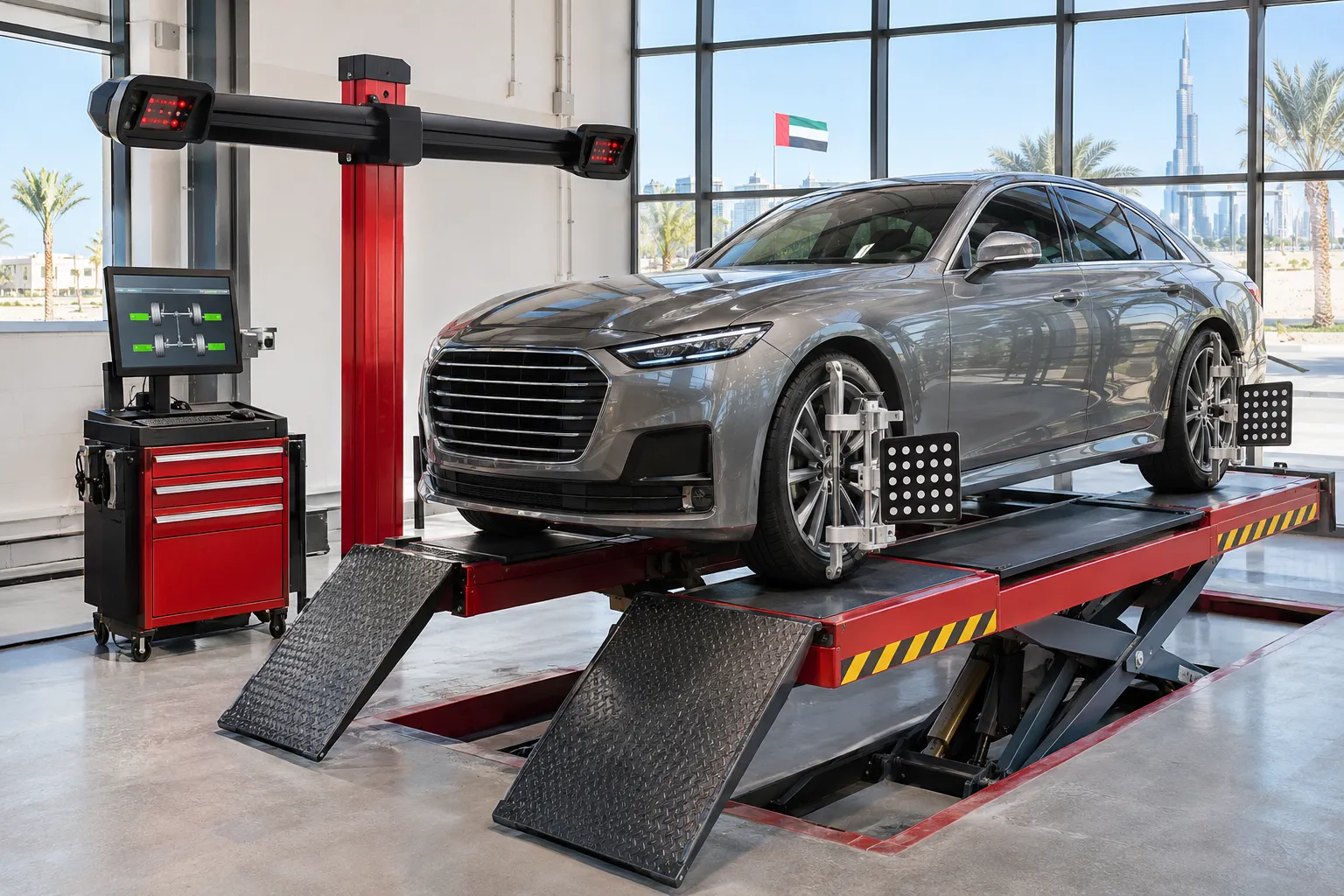
The car goes on the ramp, sensors go on each wheel, and the technician adjusts the settings to the maker’s specification. I covered the symptoms in detail in signs you need wheel alignment.
When you need both
There are times when doing one without the other leaves the job half done:
- New tyres. Balancing is part of fitting. Alignment protects the investment. A brand-new set of 18” premium tyres at AED 550–1,500 each can be ruined in a few months by bad toe.
- After a heavy impact. A big kerb or pothole hit can bend a rim (balance) and knock the geometry (alignment).
- Scalloped or cupped wear. Often a mix of balance, worn shock absorbers and alignment.
- After suspension or steering work. Alignment is a must; it’s a good moment to balance as well.
A typical week in the workshop
To show how often the two get mixed up, here are three jobs of the kind that come in most weeks.
The shaking Patrol. The owner had booked an alignment because the steering shook above 100 km/h on Emirates Road. Alignment readings were fine. On the balancer, the front left needed over 60 grams; inside the rim was a thick crust of sand from a weekend in the dunes. Clean, rebalance, done. The alignment would have cost him money and changed nothing.
The pulling Altima. The driver wanted a balance because the car “felt off”. It pulled gently right and the steering wheel sat a few degrees left. She’d hit a kerb in a Bur Dubai car park a month earlier. Toe was well out on the front right. Alignment fixed it; balancing wasn’t needed.
The new tyres on a Model 3. Four new tyres, balanced as part of fitting. We recommended an alignment as the inner edges of the old set were worn much more than the outer. The readings showed rear toe out of spec. Without the alignment, the new set would have gone the same way.
Where drivers waste money
Aligning to fix a vibration. It won’t help. Balance first.
Balancing to fix a pull. It won’t help either. Check pressures, then alignment.
Repeated rebalancing. If a vibration keeps coming back within weeks, the problem is probably a tyre with internal damage or a bent rim, not the balance.
Skipping balance after a puncture repair. A repair adds a little weight. Most of the time the shift is small, but on big, low-profile wheels you’ll feel it. We rebalance after every demounted repair.
Can it be done at home?
Balancing can. Our mobile vans carry a balancing machine, so if we’re fitting tyres or repairing a puncture at your home or office, the wheels are balanced on the spot. Alignment can’t be done properly on a driveway; it needs a level ramp and a calibrated machine, so that’s a workshop job in Al Quoz. If you’re booking a mobile tyre service in Dubai and also suspect an alignment issue, we’ll check the wear pattern and tell you whether it’s worth a workshop visit.
Prices in Dubai
| Service | Price (AED) |
|---|---|
| Wheel balancing | 25 per wheel |
| Wheel alignment, sedan | 120 |
| Wheel alignment, SUV / 4x4 | 180 |
| Alignment + balancing package | 199–249 |
| Tyre rotation | 60–80 |
Tyre rotation is often done at the same visit. Moving the wheels around means they should be rebalanced too, so we combine them.
Book the right job
If you’re still not sure which one you need, describe the symptom when you book and we’ll check before charging for anything. Our wheel balancing service is the place to start for vibration, wheel alignment for pulling and wear, and the combined package if you’ve just had new tyres fitted or hit something hard.
Frequently asked questions
Do I need balancing or alignment for steering wheel vibration?
Balancing. A steering wheel that shakes at around 80–120 km/h is the classic sign of an out-of-balance front wheel. Alignment fixes pulling and uneven wear, not vibration.
Do new tyres need balancing and alignment?
New tyres always need balancing; it's part of fitting. Alignment isn't mandatory, but it's strongly recommended so the new tyres wear evenly from day one.
How often should wheels be balanced?
Every time a tyre is fitted or removed from the rim, after a puncture repair, and whenever a vibration appears. Many drivers also rebalance every 10,000 km or so.
How much is wheel alignment and balancing in Dubai?
At our workshop, balancing is AED 25 per wheel, alignment is AED 120–180 depending on the vehicle, and the combined alignment and balancing package is AED 199–249.
About the author
Fazir Kamal — Fazir Kamal is a tyre technician with five years of hands-on work on UAE roads — roadside punctures on Sheikh Zayed Road at 2 a.m., run-flat fitments in DIFC basements, alignment on desert-driven Patrols. He writes and reviews the technical guides on TyrePuncture.ae.