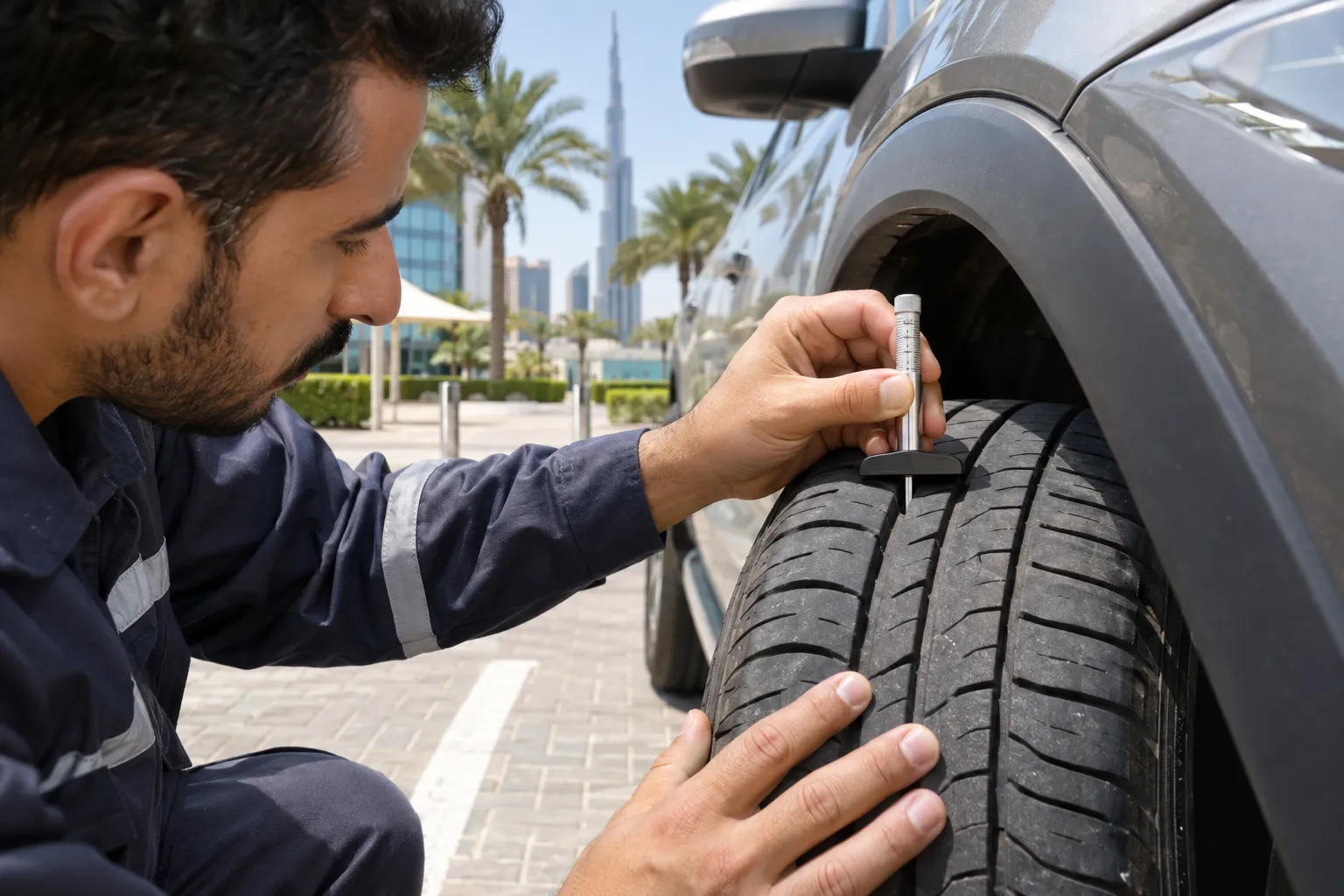
The slow leaks we find most often in Dubai
A tyre that drops 4–5 psi a week is the commonest call we get after nail punctures. The cause is often not the tread at all. Heat cycling between a 45 °C car park and a cold basement makes rubber valve stems crack at the base. Alloy rims corrode where the tyre bead sits, especially on cars that are washed often, and air seeps out along the rim edge.
We dunk the wheel in a water tank or spray it with soapy water and watch for bubbles across the tread, sidewall, valve and both bead edges. Finding the leak takes 15–30 minutes and stops you paying for a puncture plug that fixes nothing.
- Valve stem cracks: replace the valve, AED 15–25
- Bead seal leak from rim corrosion: clean the rim, reseal, refit
- Leaking TPMS sensor seal or body: reseal, or new sensor AED 220–450
- Nail or screw in the tread: plug or patch, AED 35–50 at the workshop
- Porous or cracked rim: rim repair from AED 150–300
Repair or replace: the line we will not cross
A tyre can be repaired when the hole is in the central tread area, no larger than about 6 mm, and the tyre has not been driven flat long enough to damage the inner liner. Our article can a punctured tyre be repaired? explains the rule in more detail.
We will not repair sidewall cuts, bulges, holes in the shoulder, or tyres with a ring of powdered rubber inside from being driven flat. Those tyres go back on the car only as a temporary spare-to-workshop measure, if at all. You get a photo of the damage either way, so you can see why we said no.
Prices
| Service | Price |
|---|---|
| Puncture repair at workshopPer tyre, plug or patch | AED 35–50 |
| Mobile repair call-outIncludes the repair | AED 99–149 |
| Valve replacementPer valve | AED 15–25 |
| TPMS sensorFitted and programmed | AED 220–450 |
| Rim repair (kerb rash / bead corrosion)Per rim | AED 150–300 |
Prices in AED, including VAT. Final price confirmed before work starts.
Plug, patch or both
For a straightforward nail in the tread, a roadside plug is quick and holds well. When the wheel is off the car at the workshop, we prefer a combination patch-plug fitted from the inside, which seals the liner and fills the hole. Both are covered in our plug versus patch comparison.
Run-flat tyres are a special case. Some manufacturers advise against repairing them at all; others allow a repair if the tyre was not driven deflated. We inspect the inside before giving an answer.
Repair at the workshop or where you are
If the car is drivable and you are close to Al Quoz, Al Barsha or Business Bay, bringing it to the bay costs less. For a car with a flat tyre, a low-profile wheel you do not want to drive on, or a busy day, a van comes to you with the same kit. See mobile tyre repair and fitting for what the vans carry.
After the repair
We set pressures to the door-jamb placard, not to a generic number, and reset the TPMS where needed. Re-check pressure after 48 hours, and if the warning returns, message us; a second leak point sometimes shows up only once the first is sealed. The tyre pressure guide explains what to check and when.
Tyre problems that look like repairs but are not
Some symptoms send people searching for tyre repair when the tyre is not the cause. A vibration through the steering wheel at 90–120 km/h is usually a balancing issue, or a wheel weight that flew off after a pothole. A car that pulls to one side may have a tyre with an internal belt shift, but more often it needs wheel alignment. A thump at low speed can be a flat spot from a car parked for weeks in the sun, which sometimes rolls out after a few kilometres and sometimes does not.
Other faults are tyre damage that cannot be repaired at all. A bubble on the sidewall means the internal cords have broken, usually after a kerb or speed-bump impact; the tyre must be replaced. Deep cracking across the tread grooves on an older tyre is heat ageing. Exposed wire or fabric at the shoulder means the tyre is worn far past its limit.
We check for all of these during a repair visit, because fixing a nail hole in a tyre that is about to fail elsewhere wastes your money. If the tyre has a bigger problem, you get a photo and a clear explanation before any work starts.
Services on this page
Puncture Repair
A permanent puncture repair with the tyre removed and inspected inside, using a plug-patch where the damage is in the safe repair zone of the tread.
AED 35–50 per tyreTyre Valve Replacement
Replacing cracked, leaking or damaged tyre valves and valve cores, including TPMS valve service kits, to stop slow leaks at the source.
AED 15–25 eachRim Repair
Cosmetic repair of kerb-damaged alloy rims and straightening of bent wheels, with a clear explanation of when a rim should be replaced instead.
AED 150–300 per rimTPMS Sensor Replacement
Diagnosis of TPMS warnings, replacement of failed sensors, and programming and relearn so your car reads each tyre correctly again.
AED 220–450 per sensorFrequently asked questions
Where can I get a tyre repaired near me right now?
Send your location on WhatsApp. If a van is nearby we come to you; if you are close to Al Quoz and the workshop is open, driving in is cheaper.
Can you repair a slow puncture?
Yes, once we find it. Many slow punctures are valve or rim-bead leaks rather than holes in the tread, and those are fixed differently.
Can a tyre sidewall be repaired?
No. Sidewalls flex constantly and a repair there can fail at speed. A cut or bulge in the sidewall means a new tyre.
How much does tyre repair cost in Dubai?
AED 35–50 per tyre at the workshop, or AED 99–149 for a mobile call-out including the repair. Valves cost AED 15–25.
My TPMS light stays on after the repair. Why?
Some cars need the system reset or a drive cycle to relearn. If the light flashes rather than staying solid, a sensor may be faulty. Our TPMS warning light guide explains the difference.
How many times can a tyre be repaired?
We usually allow two repairs per tyre, provided they are at least 40 cm apart and both are in the central tread area.