Puncture & Repair
Tyre Plug vs Patch: Which Puncture Repair Is Better?
Tyre plug vs patch compared by a UAE technician: how each works, how long they last, costs in Dubai and why the plug-patch combination is the proper fix.
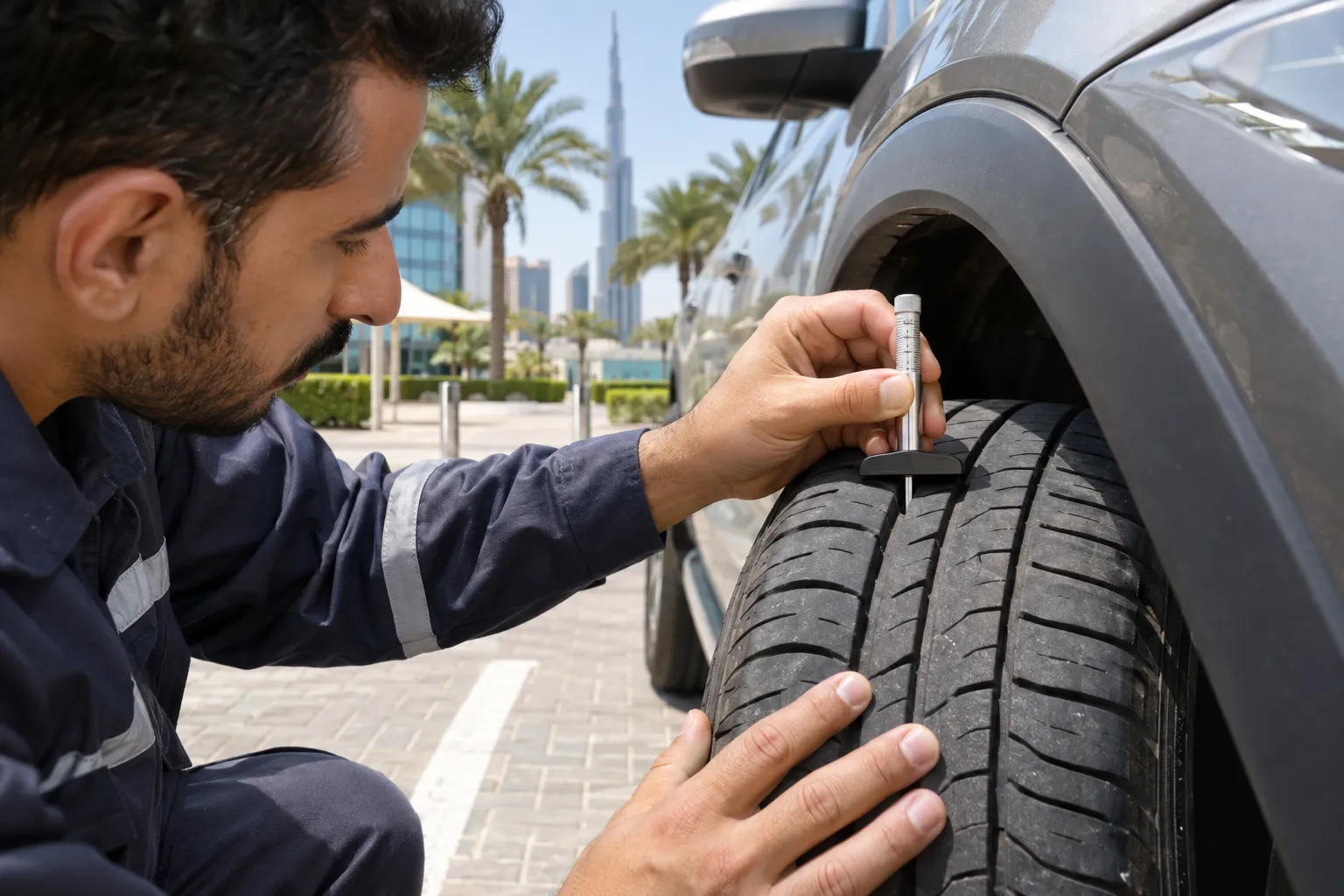
A plug seals the puncture from the outside and can be fitted without removing the tyre, so it’s quick but leaves the inside unchecked. A patch seals the inner liner from inside the tyre but doesn’t fill the hole through the tread. The proper repair combines both: a plug-patch (mushroom) unit fitted from inside after the tyre has been demounted and inspected.
If you’ve had a puncture fixed in the UAE, there’s a good chance you got a string plug. That’s not always wrong. Here’s how the three options compare and when each one makes sense.
Key takeaways
- Plug: fast, cheap, roadside-friendly, but temporary and blind to internal damage.
- Patch alone: seals the inside, but leaves the injury channel open to water and corrosion of the belts.
- Plug-patch: fills the hole and seals the liner; the standard for a lasting repair.
- All three are only suitable for tread punctures up to about 6 mm.
- Price difference at a workshop is small; the time difference is about 15 minutes.
Side-by-side comparison
| String plug | Patch only | Plug-patch (mushroom) | |
|---|---|---|---|
| Fitted from | Outside | Inside | Inside |
| Tyre removed from rim? | No | Yes | Yes |
| Inside of tyre inspected? | No | Yes | Yes |
| Fills the injury channel? | Yes | No | Yes |
| Seals the inner liner? | Partly | Yes | Yes |
| Time | About 10 min | 20–30 min | 20–30 min |
| Durability | Temporary; often lasts, sometimes leaks | Good seal, but belts exposed to moisture through the hole | Permanent for the life of the tyre |
| Where it fits best | Roadside, emergency | Rarely the best choice on its own | Workshop or fully equipped mobile van |
How a string plug works
The plug is a strip of sticky, rubber-coated cord. You ream the hole, push the plug in with a needle, pull the needle out, and trim the ends. The plug vulcanises a little in the hole as the tyre warms up.
What it does well. It gets a car off the hard shoulder in ten minutes with no specialist equipment. I’ve seen string plugs last tens of thousands of kilometres.
Where it falls short.
- You can’t see the inside of the tyre, so you can’t tell if it was driven on low pressure.
- The hole is pushed through at whatever angle the screw went in. If that angle is steep, the plug may not seal fully.
- The inner liner isn’t sealed, so air can slowly migrate into the casing.
- In our heat, a plug that seated badly tends to start leaking within a week or two.
I treat a plug as first aid. My guide on how to fix a tyre puncture walks through fitting one properly at the roadside.
How a patch works
The tyre comes off the rim. The technician buffs a patch of the inner liner around the hole, applies vulcanising cement, and presses a rubber patch over it. It’s a clean, airtight seal from inside.
The problem with a patch alone is that the hole through the tread stays open. Water, sand and grit get into it from the road side, reach the steel belts and start corrosion. Over months, rust can spread along the belt and weaken the tyre from within. That’s why a patch on its own is not the recommended repair for a puncture that goes right through the tread.
How a plug-patch works
This is a single unit shaped like a mushroom: a rubber stem that fills the hole, joined to a patch head that seals the liner.
The process in our workshop:
- Demount the tyre and inspect the inside, by hand and with a light.
- Find the exact angle of the injury and drill it clean, following that angle.
- Buff and clean the inner liner around the hole.
- Apply vulcanising cement to the channel and liner.
- Pull the stem through from inside until the head sits flat on the liner.
- Stitch the head down with a roller to remove air bubbles.
- Trim the stem flush with the tread and seal the edge of the patch.
- Refit, inflate, leak-test and balance.
It costs the same as a plug at our workshop. The only extra is about fifteen minutes.
So which should you choose?
It depends where you are and what’s happened.
You’re stuck on the hard shoulder at night
Use a plug, or call for help. Getting safely off the highway matters more than the type of repair. If you can’t do it yourself, our 24-hour tyre repair in Dubai team can come out; night call-outs between 22:00 and 06:00 carry a AED 50 supplement.
You found a nail in the tyre in your car park at home
Don’t plug it yourself if you don’t have to. Leave the nail in (it’s partly sealing the hole), check the pressure, and book a demount-and-repair. A tyre change at home visit includes the tools to do a full plug-patch on the spot.
You plugged it last week and it’s still holding
Good, but book a proper repair anyway. A quick look inside will confirm the tyre wasn’t damaged when the pressure dropped. If it’s sound, we remove the plug and fit a plug-patch in its place.
The hole is near the shoulder
Neither repair is acceptable. See can a punctured tyre be repaired for the full list of situations where the answer is no.
It’s a run-flat
A string plug on a run-flat is a bad idea because the stiff sidewall hides low pressure; you won’t feel if the plug starts leaking. Get it to a workshop and check the brand’s repair policy.
How to tell what repair your tyre already has
If you bought a used car or had a puncture fixed somewhere in a hurry, you might not know what’s in the tyre. Look at the tread:
- Short stubs of brown or black cord sticking out of the tread, or a rough patch where they’ve worn flush, usually mean a string plug from outside.
- A neat, round rubber circle flush with the tread, often slightly different in colour, usually means the stem of a plug-patch, cut flush after fitting.
- Nothing visible from outside but a known puncture history probably means a patch only, or a very well-trimmed plug-patch.
The only way to be certain is to take the tyre off the rim. We do this as part of any tyre inspection where a customer isn’t sure. If we find a string plug that’s been in for months, I don’t automatically condemn it; if the liner is clean and it’s holding, we often leave it and just note it. If the liner shows any scuffing, it gets a proper repair or the tyre gets replaced.
Common myths
“Plugs are illegal.” No. There’s no UAE rule against an external plug, but it’s not regarded as a complete repair.
“A patch is always stronger than a plug.” Not on its own. A patch without a stem leaves the belts exposed. The combination is the strong one.
“Once it’s repaired, it’s speed-limited.” A correctly fitted plug-patch in the repairable area doesn’t reduce the tyre’s speed rating. Temporary repairs and sealants do come with speed limits; follow them.
“I can repair the same tyre as often as I like.” Repairs mustn’t overlap. We stop at two per tyre.
What a good repair shop should do either way
Whichever method is used, a few things separate a careful job from a quick one. Ask whether the technician will:
- Check the tyre’s DOT date and tread depth before repairing
- Tell you if the hole is outside the repairable area, rather than plugging it anyway
- Show you the inside of the tyre if it was demounted
- Fit a new valve if the old one is cracked or corroded
- Rebalance the wheel after a demounted repair
- Set all four pressures before you leave
If the answer to most of those is yes, the repair method is in good hands.
Cost of each option in the UAE
| Repair | Price (AED) |
|---|---|
| Plug, patch or plug-patch at the workshop | 35–50 per tyre |
| Mobile repair, call-out included | 99–149 |
| Night supplement (22:00–06:00) | +50 |
| Replacement if not repairable | from 180 |
The repair I’d put on my own car
A plug-patch, every time I have the choice. A string plug in the boot for emergencies, then a proper repair within a day or two. If you’re near Al Quoz, drive in; if not, book our flat tyre repair service and a van will come to you with everything needed to demount, inspect and fit a plug-patch where you’re parked.
Frequently asked questions
Is a tyre plug a permanent repair?
An external string plug often holds air for a long time, but it isn't considered a permanent repair because the inside of the tyre hasn't been inspected or sealed. Use it to get moving, then have a plug-patch fitted.
What is a mushroom plug?
A mushroom plug, or plug-patch, is a single repair unit with a rubber stem and a patch head. The stem fills the hole and the head seals the inner liner. It's fitted from inside the tyre after demounting.
How much does a tyre patch cost in Dubai?
At our workshop a plug, patch or plug-patch repair costs AED 35–50 per tyre. A mobile repair where we come to you is AED 99–149 including the call-out.
Can I plug a tyre myself and keep driving on it?
For a short distance at moderate speed, yes. Check the pressure daily, keep below 80–100 km/h, and get the tyre demounted and inspected within a few days.
About the author
Fazir Kamal — Fazir Kamal is a tyre technician with five years of hands-on work on UAE roads — roadside punctures on Sheikh Zayed Road at 2 a.m., run-flat fitments in DIFC basements, alignment on desert-driven Patrols. He writes and reviews the technical guides on TyrePuncture.ae.