Puncture & Repair
How to Change a Tyre: Step-by-Step from a Technician
How to change a car tyre safely in 15 minutes: tools, jack points, loosening order, star-pattern tightening and the mistakes I see on UAE roadsides weekly.
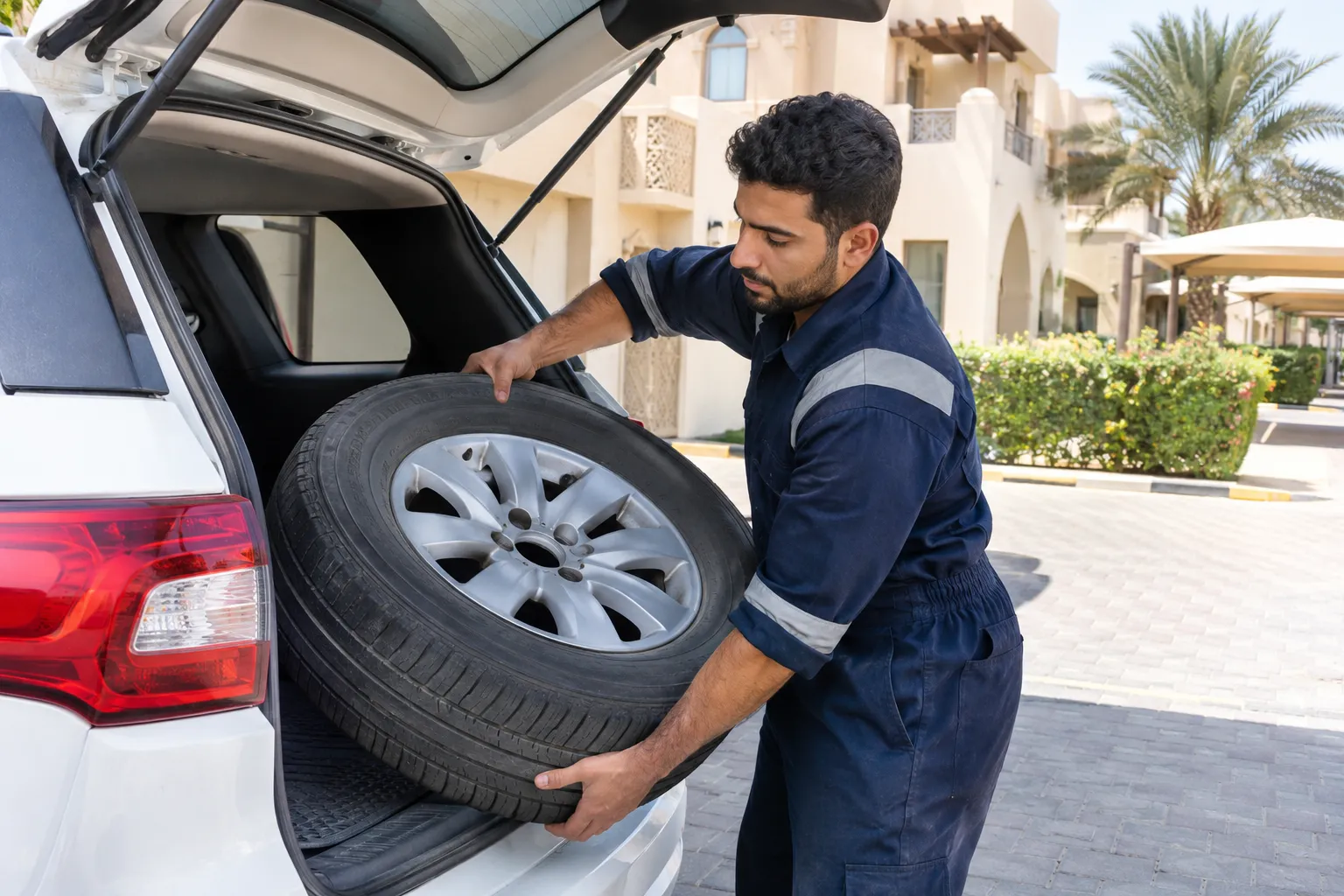
To change a tyre, park on flat, firm ground away from traffic, apply the handbrake, loosen the wheel nuts half a turn while the wheel is still on the ground, then jack the car at the correct lifting point. Remove the nuts and the flat wheel, fit the spare, tighten the nuts by hand in a star pattern, lower the car and tighten them fully. The whole job takes about 15–25 minutes the first time.
Key takeaways
- Loosen the nuts before lifting the car, and do the final tightening after lowering it.
- Use only the jack points marked in your owner’s manual. The wrong spot can bend the sill or let the car fall.
- Never put any part of your body under a car held up only by a jack.
- Check the spare’s pressure every month. A flat spare is the most common surprise I see.
Before you start: is it safe here?
Changing a tyre is easy. Changing one in the wrong place is how people get hurt. Don’t attempt it:
- On a highway hard shoulder with the flat on the traffic side.
- On sand, gravel or a slope. Basement car parks are fine if the floor is level.
- If you don’t have a working jack, a wheel brace that fits, the locking nut key and an inflated spare.
If you’re on a fast road, read what to do with a flat tyre on the highway first. If the spot isn’t safe, a mobile spare tyre fitting call-out is the better choice.
What you need
| Item | Where it usually is | Check before you need it |
|---|---|---|
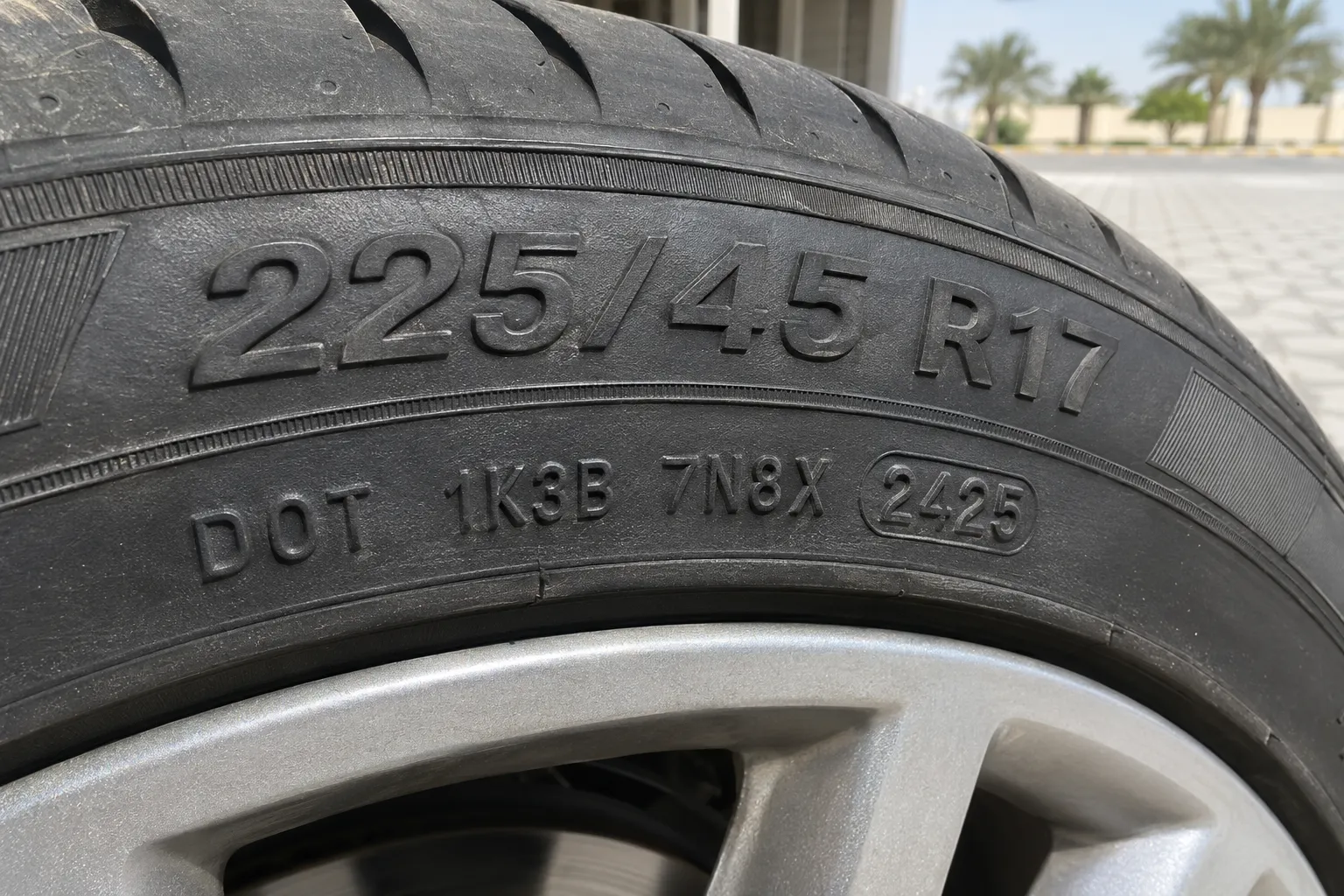
| Spare wheel (full-size or space-saver) | Under the boot floor or under the car (SUVs, pickups) | Pressure, DOT date, no cracks |
| Jack | Boot side panel or under the floor | All parts present, winds up smoothly |
| Wheel brace (lug wrench) | With the jack | Fits your nuts |
| Locking wheel nut key | Glovebox, boot tray or jack kit | Know where it is |
| Owner’s manual | Glovebox | Jack points and nut torque |
| Gloves, torch, small mat | Add these yourself | Summer metal gets hot enough to burn |
| Wheel chock or a brick | Add this yourself | Stops the car rolling |
Some newer cars have no spare at all, just a sealant kit or run-flat tyres. Check what’s in your boot this week, not on the day you need it.
How to change a tyre in 12 steps
- Park and secure the car. Engine off, handbrake on, automatic in P (manual in first or reverse). Hazard lights on.
- Get passengers out and away from the road.
- Chock the wheel diagonally opposite the flat. If the front left is flat, chock the rear right.
- Take out the spare and tools. Lay the spare flat near you; if anything goes wrong it can go under the car’s sill as a safety block.
- Remove the hub cap or nut covers if your car has them.
- Loosen each wheel nut half a turn, anti-clockwise, with the wheel still on the ground. Use your body weight on the brace, pushing down, not pulling up. Don’t remove them yet.
- Position the jack at the correct lift point. On most cars it’s a reinforced notch on the sill just behind the front wheel or in front of the rear wheel. Your manual shows it.
- Raise the car until the flat tyre is about 5 cm off the ground. You need more height to fit the spare than to take off the flat, because the spare is fully inflated.
- Remove the nuts and the wheel. Keep the nuts together in a cap or pocket. Pull the wheel straight towards you. It’s heavy; keep your back straight.
- Fit the spare. Line up the holes with the studs, push it fully on, and thread all nuts by hand first so none are cross-threaded.
- Snug the nuts in a star pattern with the brace, then lower the car until the tyre touches the ground and takes some weight.
- Tighten fully in a star pattern, then lower the jack completely and remove it. Give each nut one final firm pull.
Stow the flat wheel and the tools. A loose jack in the boot becomes a missile in a hard stop.
The star pattern, explained
Tightening nuts in a circle can pull the wheel slightly off-centre. On a five-nut wheel, tighten one nut, then skip one and tighten the next, working around in a star until all are done. On a four-nut wheel, go diagonally across. This seats the wheel evenly against the hub.
Troubleshooting common problems
A nut won’t budge
Wheel nuts on UAE cars are often over-tightened with an impact gun and then baked in the heat for months. Make sure the brace is fully seated, then stand on the end of the brace and bounce gently. Never use a pipe extension on the cheap factory brace; it can snap. If it still won’t move, stop and call a mobile tyre service with proper tools.
The wheel is stuck on the hub
Alloys can corrode onto the hub. With the nuts loosened a few turns but still on, lower the car and roll it forward and back a metre; that usually frees it. Then lift again and remove the nuts.
The jack is sinking or tilting
Stop and lower the car immediately. Find firmer ground or put a strong flat board under the jack. Never continue on a tilting jack.
The spare is flat
This happens far too often. If you have a portable compressor, inflate it to the pressure on the tyre or placard. If not, put the original wheel back on and call for help.
Space-saver spare: the rules
Many sedans and hatchbacks carry a thin temporary spare, usually with a yellow or orange label. It’s meant to get you to a tyre shop.
- Keep below the speed on the label, usually 80 km/h.
- Avoid long highway trips; a single trip from Dubai Marina to the workshop is fine, Dubai to Abu Dhabi is not.
- Pressure is often much higher than normal tyres, commonly around 60 psi. Check the sidewall.
- ABS and stability control may behave slightly differently. Leave extra braking distance.
Changing a tyre on an SUV or 4x4
Bigger vehicles follow the same steps, with a few differences that catch people out:
- The spare is often under the car. On a Land Cruiser, Patrol, Pajero or pickup, the spare hangs under the rear on a cable winch. The winch key usually fits through a small hole near the number plate or bumper. Lower it slowly, and keep the mechanism clean, because sand and rust make it seize.
- Bottle jacks are common on 4x4s. They lift high but have a narrow base. Use them only on firm ground, and on sand or gravel put a board underneath.
- Wheels are heavy. A 265/70 R17 all-terrain tyre on an alloy can weigh more than 30 kg. Roll it, don’t carry it, and lift with your legs.
- Rear-mounted spares on the tailgate are easier to reach but are often older than the road tyres. Check the DOT date.
- Higher torque values. Large SUVs and pickups often use higher wheel-nut torque than sedans. Check the manual.
If your SUV has been in the desert, clear the sand from the hub face before fitting the spare. Grit between the wheel and hub stops it seating flat, which causes vibration and can loosen the nuts. More SUV-specific advice is on our SUV and 4x4 tyres page.
After you’ve changed it
- Have the nuts torqued to the correct setting at a tyre shop. Most cars sit somewhere around 100–140 Nm; your manual has the exact figure.
- Re-check the nuts after 50 km. Alloy wheels can settle.
- Get the damaged tyre looked at. Many tread punctures can be plugged or patched; a sidewall cut can’t. See plug vs patch for the difference.
- Put the repaired or new tyre back on and return the spare to the boot, inflated.
The mistakes I see most
In five years on roadside calls, I’ve seen the same handful of errors again and again:
- Jacking first, loosening second. The wheel just spins in the air. Put it down and start over.
- Wrong jack point. I’ve seen crumpled sills and one car slip off the jack in a JLT car park. Luckily nobody was underneath.
- Nuts tightened in a circle, causing a vibration the driver thinks is a balancing problem.
- Fitting the spare and forgetting the flat. A month later the punctured tyre is still in the boot, and so is the nail. Book the puncture repair the same day.
- Leaving the space-saver on for weeks. They wear quickly and aren’t built for 120 km/h on Mohammed Bin Zayed Road.
Prefer someone else to do it?
Changing a wheel is a useful skill, but you don’t have to do it in 44 °C heat in your work clothes. Our vans come to your home, office or roadside location in Dubai, Sharjah and Abu Dhabi, fit your spare or a new tyre, and torque the nuts properly. Book a tyre change at home in Dubai, or see the full details of our tyre change service.
Frequently asked questions
How long does it take to change a tyre?
About 15–25 minutes for a first-timer on flat, firm ground with the right tools. A technician with a trolley jack and impact gun does it in 5–10 minutes.
How tight should wheel nuts be?
Most passenger cars use roughly 100–140 Nm, but it varies by make, so check your owner's manual. Without a torque wrench, tighten firmly with the wheel brace by hand, then have them torqued properly at a tyre shop and re-checked after about 50 km.
How fast can I drive on a space-saver spare?
Most temporary spares are limited to 80 km/h; the exact limit is printed on the tyre or a sticker on the rim. Treat it as a way to reach a tyre shop, not a replacement.
Can I change a tyre without a locking wheel nut key?
Not safely. Without the key, the locking nut has to be removed with a special extractor tool. Check now where your key is kept; it is usually in the glovebox, boot tray or with the jack.
About the author
Fazir Kamal — Fazir Kamal is a tyre technician with five years of hands-on work on UAE roads — roadside punctures on Sheikh Zayed Road at 2 a.m., run-flat fitments in DIFC basements, alignment on desert-driven Patrols. He writes and reviews the technical guides on TyrePuncture.ae.